Premium hearing aids in Korea, at about half the US price.
English, Chinese and Japanese service. Japanese-speaking staff at our Songpa center.
Call 1577-5086KakaoTalk한국어

For friends and family too RecommendedWould you like to?

9.77/10

Full survey of all 1,286 wearers

9.77Average
0 1 2 3 4 5 6 7 8 9 10

Not at all
Not recommended

Average

Proactive
Recommended

High satisfaction rate, The reason is simple.

On your first visit,
Fitting the one that's right for me
you hear well the first time.

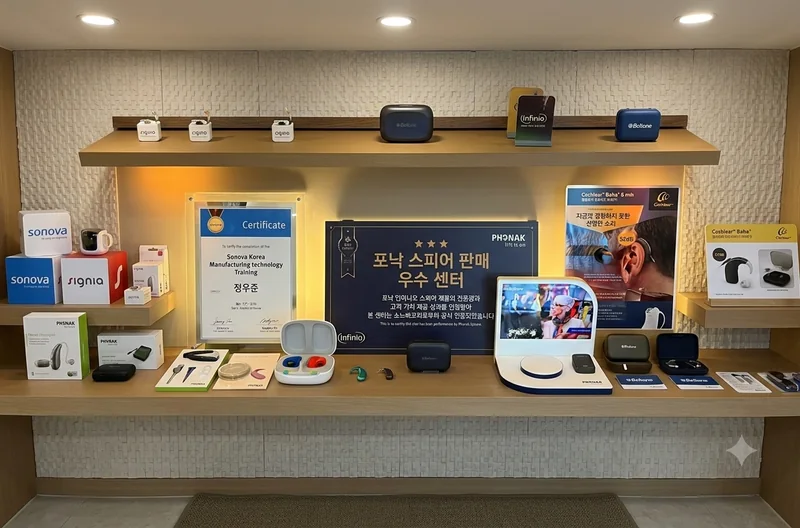
Official dealer of the world's 6 major brands

To a specific brand does not tip the scales

The one that fits your ears just right Clear-headed and objective We assess and fit for you.

Phonak logo Phonak
Oticon logo Oticon
Widex logo Widex
Signia logo Signia
Starkey logo Starkey
Beltone logo Beltone
See the objective brand-by-brand comparison table
The sound With expertise and dedication It becomes more precise.

Through a 12-step customization system We let you experience the best possible sound.

Confidence backed by evidence See details

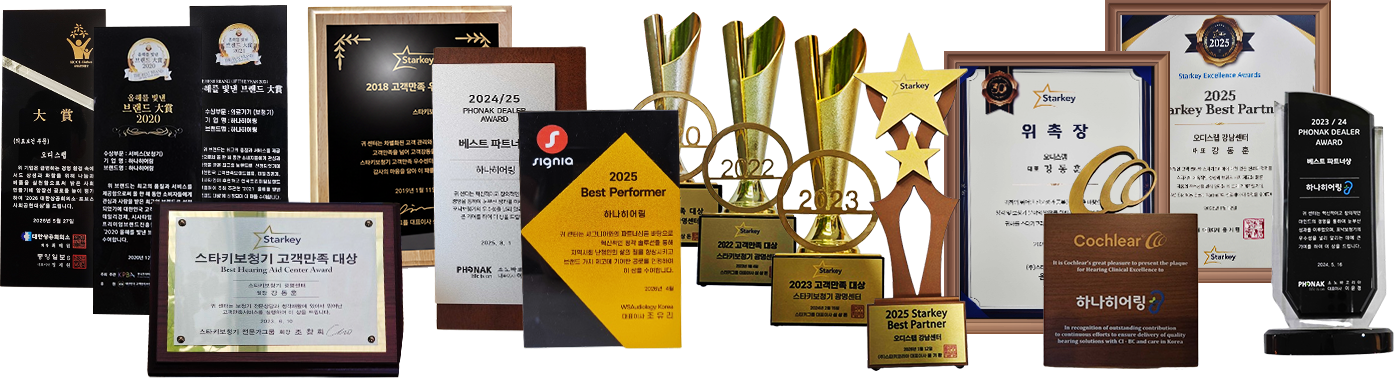
Global manufacturers and the press
Consistently recognized Hana Hearing

See details
  • 2026
    Forbes Korea Social Contribution Awards, Grand Prize in the Medical and Healthcare category
  • 2026
    Starkey Korea appoints CEO Kang Dong-hoon as an advisory committee member
  • 2025
    Signia 2025 Best Performer
  • 2025
    Phonak Sonova Best Partner Award
  • 2024
    Winner of the Starkey Customer Satisfaction Award for 6 consecutive years
  • 2024
    Cochlear Korea, sole winner in two categories (including most bone-conduction units sold)
  • 2024
    Phonak Sonova Best Partner Award
  • 2021
    Brand of the Year Grand Prize, Medical Device (Hearing Aid) category

Hana Hearingfound only at 6 principles

Principle 1 Confident enough to recommend to our own mother
What we can fit for you
We fit hearing aids only.

We fit only the hearing aids we could proudly fit for our own family.
In testing, in fitting, and in aftercare, we give our full care, as if looking after our own mother and father.

Principle 2 Operated 100% by appointment,
Consultation counts by time of day
We strictly limit it.

rather than seeing many customers quickly,
We provide careful, individualized fitting for each and every person.
This is the philosophy Hana Hearing has upheld from its earliest days.

Principle 3 With a relentlessly precise 12-step process
We build a scientific, customized rehabilitation plan.

We don't judge by hearing numbers alone.
From ear canal volume to rehabilitation of the auditory perception area,
We design your hearing with a 12-step protocol found nowhere else, at home or abroad.

Principle 4 At the price of a single convertible imported car,
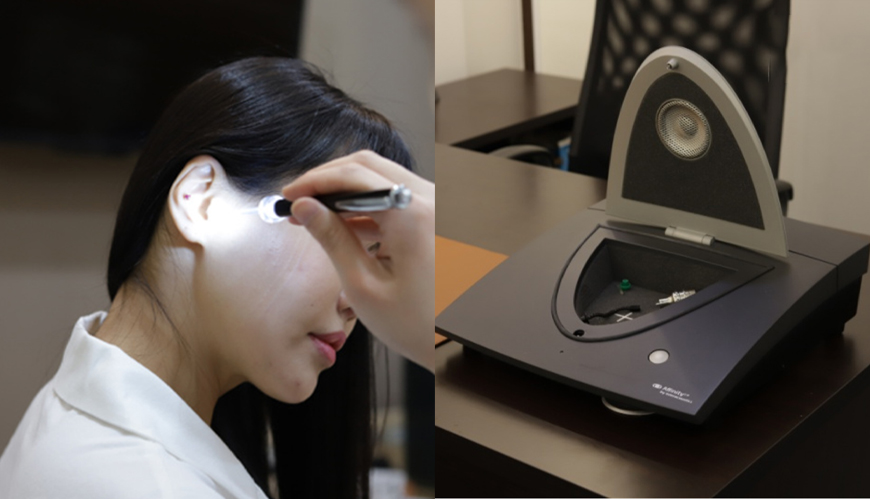
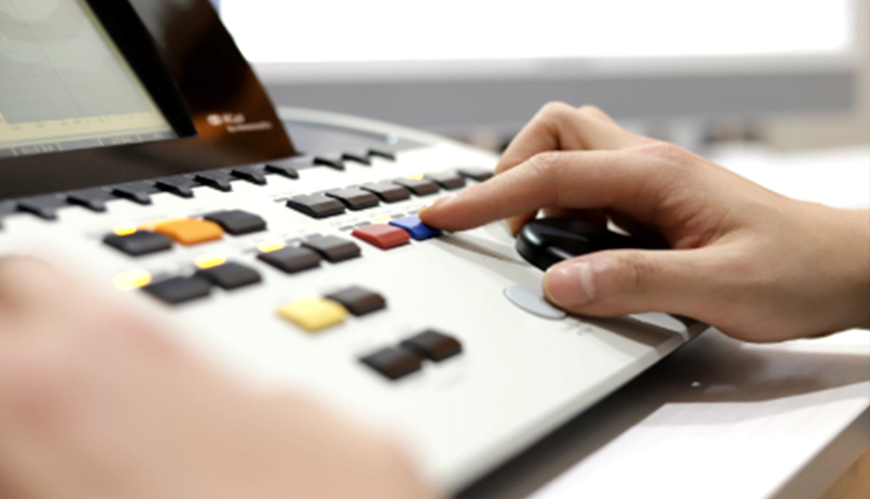
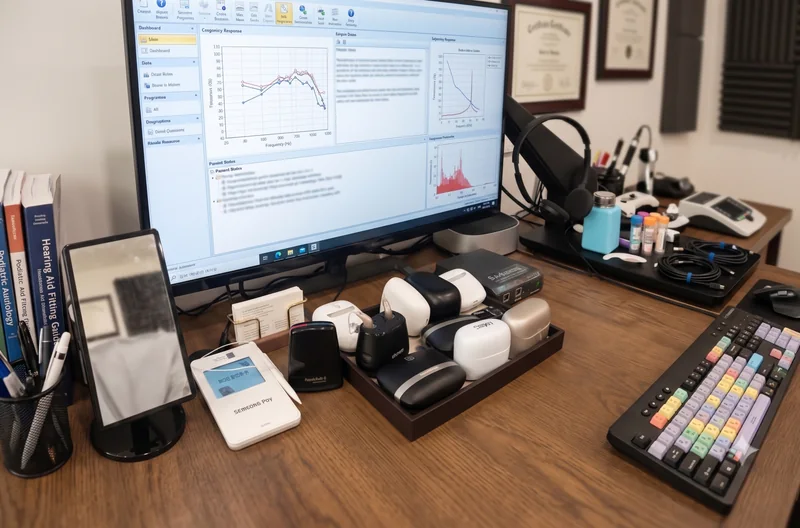
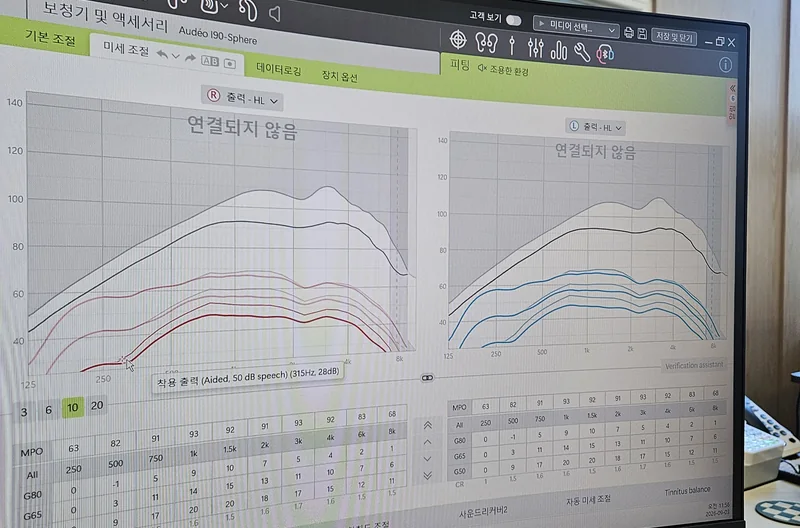
We use precision testing equipment.

In hearing aid fitting, the performance of the device
It matters as much as the audiologist's skill.
This is why Hana Hearing invests generously in equipment.

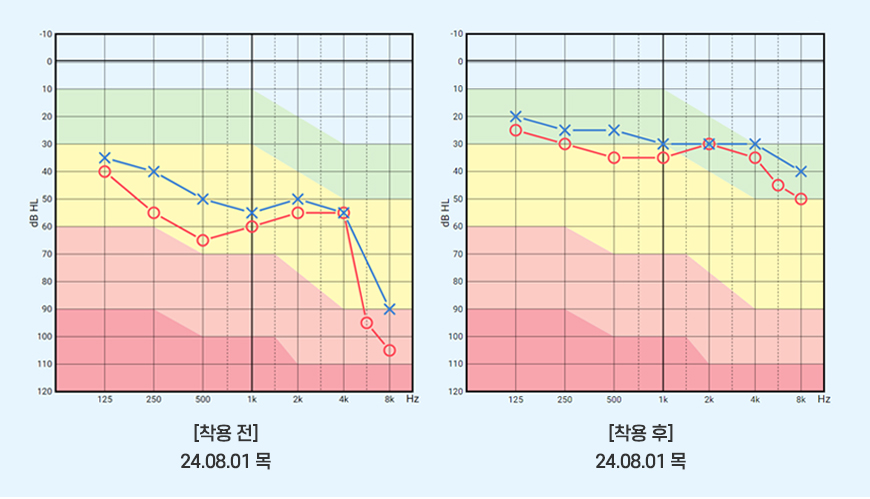
Principle 5 the improvement before / after wearing
we show you in the results.

So that you are never left wondering, “Has it really improved?”,
we will show how much your hearing has improved, exactly as it is.
Hana Hearing is that confident.

Principle 6 Prices with no markup
We'll confirm it for you.

Hana Hearing, Korea's largest hearing aid network,
We achieve economies of scale.
This comes back as a benefit to our customers.

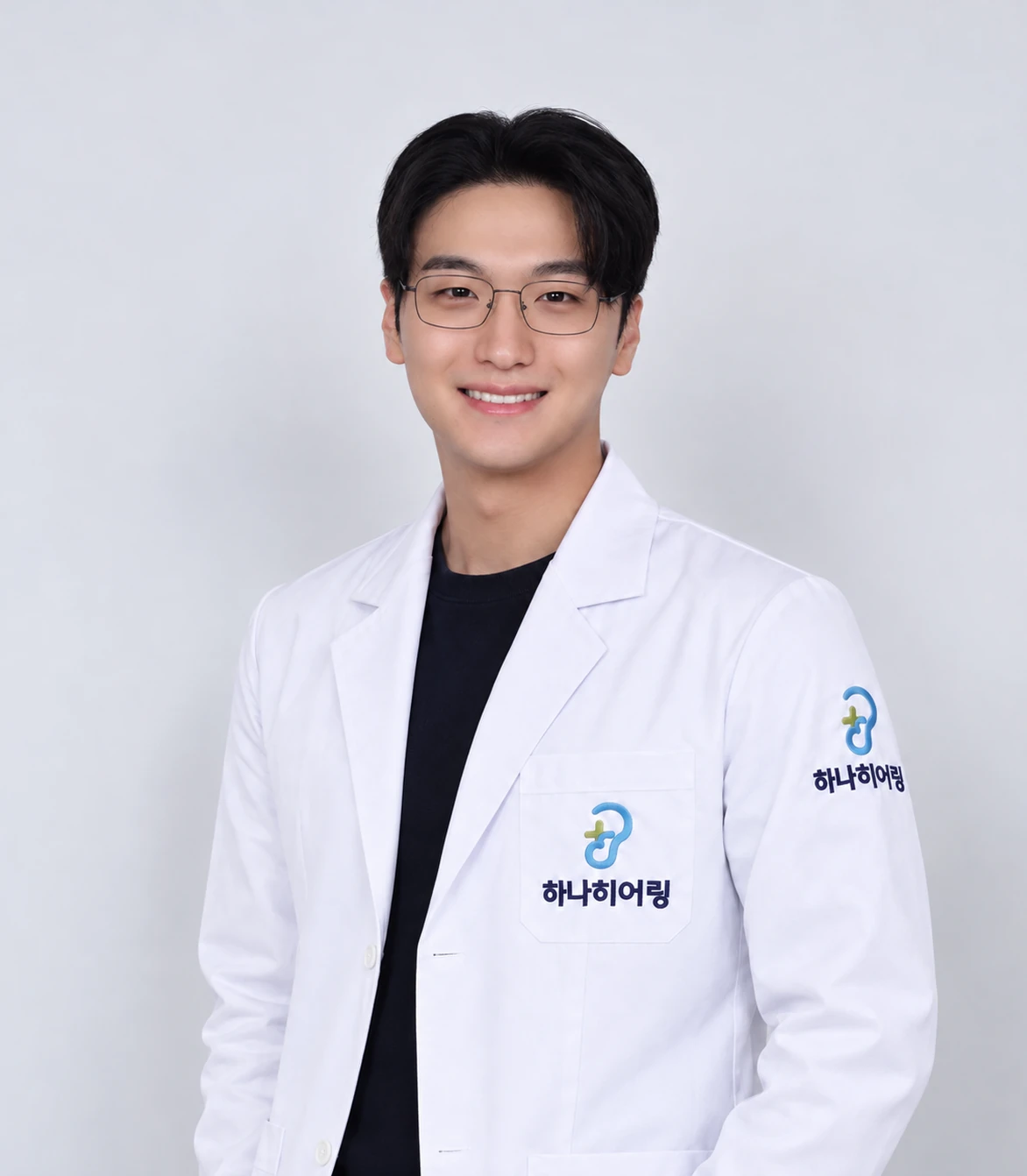
CEO Kang Dong-hoon

Hana Hearing CEO / Certified Audiologist

Kang Dong-hun

Completed doctoral coursework, master's, and bachelor's degrees in audiology

We will fit precisely and look after you all the way.

View the CEO's message
Real-life reviews
Hana Hearing, where word of mouth is the lifeline
Us Most of our sales come from referralsis made up of.
["Four questions went by while I cracked two eggs"] - Widex SmartRIC open-fit fitting review

Hello. This is director Lee Byunghee of the Hana Hearing Incheon Juan center. The customer who visited this time was a woman in her 70s.     The story the customer told as we began the consultation still stays with me. She was in the middle of talking with her family at home. She was cracking eggs in the kitchen, and a family member kept asking her questions from behind. But in the time it took to crack two eggs, she had to have the same question repeated four times. "What did you say?"  "Say that again." At first, the family did not think much of it either.     Reason for the visit What troubled the customer most was not 'sound' As the consultation began, director Lee Byunghee did not simply check whether a hearing aid was needed. First he checked, one by one, which everyday situations she found hardest.   The difficulties the customer described Hard to understand when family speaks from behind Keeps turning the TV volume up Misses the conversation when several people talk together Hard to make out quiet voices Can hear speech but keeps having to confirm what was said Hard to talk with family while working in the kitchen   Of all of them, the words that came up most often were these. "I can tell that someone is speaking, but I just cannot hear what they are saying."     Pure-tone hearing test results The test confirmed hearing loss in both ears, close to the moderately severe range. Test item Right Left Average threshold 61 dB HL 64 dB HL MCL 95 dB HL 100 dB HL WRS 64% 60% In her case, it was not that she couldn't hear any sound at all, to the point where everyday conversation was impossible. But with hearing loss, it takes more concentration to hear the other person's voice, and when other sounds mix in nearby, telling speech apart can become even harder.   In particular, for someone like her who feels that "I can hear sound but I miss the meaning," simply turning up the hearing aid's volume is not the right approach. So in this fitting we focused on letting her hear speech comfortably while keeping the surrounding environmental sounds from becoming too much.     Final product choice The hearing aid chosen for the customer It is the Widex SmartRIC, an open-fit style hearing aid.   From the start, she was uneasy about using a hearing aid turned up loud. So we first checked whether her ears felt blocked when wearing it, and carried out the fitting while checking how much sound she could comfortably accept in real conversation. Choosing a product does not mean the fitting is finished. If anything, this is where the process of adjusting step by step to her hearing begins.     Custom fitting Low frequencies kept modest, high frequencies centered on speech Based on her test results, we adjusted the amount of compensation at each frequency.   250-500Hz low-frequency range If the low-frequency range is raised more than necessary, the surrounding humming and everyday noise can feel excessively loud. So, to keep her from feeling that blocked-up sensation, we applied low-frequency amplification only as much as her hearing loss required.   1,000-2,000Hz mid-frequency range We adjusted while checking her responses so she could hear speech most comfortably when talking with family. In particular, we repeated the process of asking her questions directly and listening to her answers. Whether she answered after hearing once, whether the question had to be repeated, whether the voice felt too loud, and whether speech sounded natural, we checked each of these one by one.   3,000-4,000Hz high-frequency range Keeping in mind the thing she complained about most, **"I can hear the words but cannot tell what they mean,"** we finely adjusted the high-frequency range as well. We applied the needed compensation so the fine detail of speech would not be lost, while also checking that the high-frequency sounds did not feel sharp.   We also used HAF360 to recreate 'talking with family in the kitchen' For this customer we made particular use of HAF360 fitting. That is because her typical trouble spot was not a quiet test room but talking with family in her living space. As she described, when she is working in the kitchen and family speaks from behind, or everyday sounds arise at the same time, speech can be missed.   So we recreated a virtual sound environment and checked how conversation sounds when surrounding noise is present. At first, when the surrounding sounds and the speech came in together, "Here it sounds a little mixed together." is what she said. From there, we checked the fitting again. Rather than just cutting the surrounding sounds, we finely tuned things around the speech she needed to hear so it would be easy to follow. Then we asked her again.   This time she answered right away. "Now the words sound a bit clearer." This is exactly why we carried out the HAF360 fitting. Because hearing well in the test room and actually hearing well in the customer's home can be two different things.     After-care With a hearing aid, what comes after the fitting day matters more than the day itself This is the part we emphasized most to the customer in this consultation, too. It does not all end on the first day of wearing a hearing aid. As you actually use it, "This sound is a little loud." "In this situation the speech is too soft." "At restaurants the surrounding noise is too much." New responses like these can come up.   That is why Hana Hearing continues to provide care even after you start wearing the hearing aid, through its 8 free-repair services. We carry the customer's test results, consultation records, and the concerns found during fitting forward through integrated customer management, and reflect them in later fittings. And through Hana Hearing's nationwide after-care, care is not limited to the single place where you bought the device, so you can keep getting help.   After hearing this, the customer, too, "The first fitting matters, but hearing that you keep looking after me afterward puts my mind at ease." is what she kindly told us.     Price and benefits If you have been putting off a hearing aid because of price Worries about price are an unavoidable part of any hearing-aid consultation. Backed by winning the top sales award for six years running, Hana Hearing uses bulk purchasing to offer hearing aids at exceptionally reasonable prices, among the best in the industry. We also lower the burden with no-markup pricing up to 70% below the manufacturer's suggested retail price, and for customers eligible to register as hearing-impaired we explain the registration procedure and help with the related steps. Once you are registered as hearing-impaired, through the government support program there are cases where a 1.3 million won hearing aid can be fitted with only 100,000 won in out-of-pocket cost, so we check your eligibility together with you.   Incheon Juan #Juan #HearingAids #Audiologist #Fitting #MichuholGu #Consultation #HanaHearing #HanaHearingJuan #Repair #JuanStation #GanseokStation #SeokbawiMarket

2026.09.21 Incheon Juan
Fitting review of a man in his 60s who could not hear the conversation well when six people sat together at a restaurant

Hello. This is Kim Hee-jung, director of the Hana Hearing Cheongju center.  The customer who visited the Cheongju center this time was a male customer in his 60s.     What led the customer to decide on a hearing aid consultation began at a very ordinary mealtime. He had booked a restaurant to have a meal with family, and the reservation sheet listed 6 people. But once the meal actually began, a problem arose. With six people sitting at one table talking, he said he couldn't hear well what the person across from him was saying, and when people at the next seats talked it was even harder to make out. In a restaurant especially, people's voices + the clatter of dishes + conversation at nearby tables  came all at once, so he said that while he could tell the other person was speaking, he often missed what was actually being said.       Reason for visiting During the consultation, director Kim Hee-jung did not just listen to "I can't hear well." She started by finding out where, with which sounds, and how much the customer struggled.   The situations the customer found most uncomfortable A restaurant where many people talk together When watching TV When family talk at their usual volume When spoken to from behind When there is noise nearby When listening to women or soft voices   What the customer mentioned most of all was this. "It's not that I can't hear sound at all, but it's hard to make out people's words accurately." To check this, we carried out pure-tone audiometry and the word recognition score (WRS) test together.     Pure-tone audiometry results The results confirmed hearing loss in both ears falling in the moderate to moderately-severe range. Category Hearing test result Right average hearing threshold 52 dB HL Left average hearing threshold 59 dB HL MCL 90 dB HL WRS 80% For this customer, the important issue was not so much failing to hear loud sounds, but the difficulty he felt making out speech clearly. So, rather than fitting the hearing aid by simply amplifying everything, we set the fitting direction based on the customer's hearing thresholds, MCL, and WRS so that he could hear real speech comfortably.     Final product selected The hearing aid selected for this customer was the Signia Pure Charge&Go BCT IX open-fit hearing aid.   Since the customer was wearing a hearing aid for the first time, we considered comfort, and above all we took as the most important criterion the fact that conversation is hard in environments with a lot of surrounding sound, such as a restaurant. Choosing the hearing aid is not the end; the real fitting process begins from here.     Precise fitting A detailed fitting based on the hearing test results After checking the customer's hearing status, we adjusted the amount of compensation by frequency.   Low-frequency range We compensated the low frequencies as much as needed while avoiding excessive amplification, so the customer would not feel discomfort. This is because making the low frequencies loud no matter what can make surrounding droning sounds and restaurant background sounds feel loud as well.   1,000-2,000Hz range Because this is an important range in real conversation, we adjusted it finely so the customer could hear the other person's voice comfortably. With the hearing aid on, we held conversations directly and kept checking whether the voice was too quiet, or conversely whether it echoed or felt overwhelming.   3,000-4,000Hz high-frequency range We compensated with the fine details of speech that the customer found especially difficult in mind. Because the high-frequency range is important for hearing speech information such as consonants, we reinforced it as much as needed based on the hearing test results. Rather than simply raising the high frequencies a lot, we adjusted while checking the customer's responses.   We also carried out HAF360 fitting For this customer, the most important thing was not hearing well in a quiet space, but being able to have a conversation in a noisy place like a restaurant. So, using HAF360 fitting, we recreated a virtual acoustic environment like what he might experience in real life.   Based on the situation the customer found most difficult, we checked speech in an environment with surrounding noise. At first the customer said, "With so many people, it feels like all the sound blends together." From that state, we checked the fitting again and adjusted the parts that needed it. Rather than making surrounding noise quiet no matter what, we focused the fitting so the customer could distinguish the speech he needs to hear from the surrounding sounds he doesn't need to hear.     Aftercare Hana Hearing, with care that extends to 8 complimentary repair services A hearing aid is not a product where everything ends on the day you buy it. The sound may feel different as you wear it, and discomfort can arise depending on the season or living environment. So at Hana Hearing we guide you so that the hearing aid can be managed continuously through the 8 complimentary repair services.   It is important to keep following up, through integrated customer care, on everything from the customer's test results to the consultation notes and the discomforts identified during the fitting process. In addition, through Hana Hearing's nationwide aftercare, we make sure the customer isn't done after a single visit but can keep receiving care continuously. After being guided on this part, the customer also said, "With a hearing aid, I was more worried about getting care later than about the first fitting, so hearing that there are 8 complimentary repair services is reassuring."   #CheongjuHearingAid #HeungdeokguHearingAid #GangseodongHearingAid #CheongjuHearingLossConsultation #CheongjuHearingAidRepair #CheongjuSeniorHearingAid #CheongjuAudiologist #HanaHearingCheongju #CheongjuHearingAidRecommendation

2026.09.21 Cheongju
"A customer in her 50s whose conversations kept cutting out in noisy gatherings finds her way back to sound"

Hello. I am Kim Seung-ho, director of Hana Hearing Paju Yadang center. The person who visited our center this time was a woman in her 50s.     As we began the consultation, she told us the following. "When I go to a cafe or a gathering, I'm clearly sitting face to face with people talking, but the moment the surrounding sounds overlap even a little, I lose track of what's being said. Especially when several people talk at once, it's so hard to join the conversation." This was not simply a problem caused by sounds being too quiet. In everyday one-on-one conversation she didn't feel much discomfort, but in small gatherings with acquaintances or in places with echo, the other person's voice mixed with the surrounding noise so that sentences didn't connect smoothly. She said that especially after a gathering ended, she felt a strong sense of fatigue and regret, wondering 'Did I fail to focus properly on the conversation?' So this fitting was carried out not in the direction of simply making the hearing aid louder, but with a focus on clearly separating speech even amid complex noise to reduce that fatigue.     1. Reason for the visit She told us that she usually didn't feel much discomfort when watching TV at home or talking with family in a quiet place. So at first she never imagined there might be a problem with her hearing. But at some point, small inconveniences in daily life began to pile up. At gatherings with many people or in cafes, conversations didn't come through clearly, when the clatter of dishes or background music was present, the other person's voice was buried, parts of sentences dropped out during conversation, so she kept asking "Could you say that again?", and after a gathering, she felt so fatigued from straining to hear rather than following the conversation that her head felt heavy. She confided that she was fine in quiet places, but the moment there were a few more people or some noise, speech sounded garbled. "I thought everyone's ears just get duller with age; I didn't realize my hearing had gotten worse." Hearing this, we proceeded all the more carefully, step by step, starting with the hearing test.     2. Hearing test results Pure-tone audiometry | Hearing loss appearing in the high-frequency range First, through pure-tone audiometry, we carefully checked the hearing thresholds at each frequency. Frequency Right Left 250Hz 35 dB HL 30 dB HL 500Hz 40 dB HL 35 dB HL 1,000Hz 45 dB HL 40 dB HL 2,000Hz 52 dB HL 48 dB HL 4,000Hz 60 dB HL 58 dB HL 8,000Hz 65 dB HL 62 dB HL The results showed hearing loss ranging from mild to moderately severe, with the typical pattern of thresholds rising as the frequency got higher. In such cases, simply turning all the sound up can instead make sounds echo or feel noisy, lowering satisfaction. So we then carefully carried out a word recognition score test (WRS) and MCL (most comfortable listening level) alongside it. The word recognition score results were as follows. Right WRS: 70% Left WRS: 75% Being able to hear sound with the ears and accurately distinguishing the incoming words in the brain are two different things. She too agreed during the testing. "It's not that I can't hear at all, but speech doesn't register clearly; it feels buried in a murmur." This was exactly what we set as the core task of this fitting. MCL measurement | The point that stays comfortable while preserving speech clarity While observing her responses to speech stimuli, we also measured the MCL. Right MCL: 82 dB HL Left MCL: 78 dB HL We referred to her age range and hearing range, but above all we tuned the final fitting direction around the comfort she personally felt. Rather than just filling her ears with loud sound, it was important to find the optimal balance that stays comfortable even with long wear while not missing even the consonants of the other person's speech.     3. Final product choice The product we carefully chose together with her this time is the Signia BCT 5IX open-fit hearing aid. Rather than an in-the-ear type that tightly plugs the ear, she preferred an open type with less echo and a natural fit. The Signia BCT 5IX offers excellent speech-processing technology and a natural listening experience, with a strength in separating the other person's voice more cleanly in everyday conversation and small-gathering settings. Taking into account her hearing test results, the gathering environments she often attends, and her listening preferences all together, it was the most ideal choice.     4. Custom fitting HAF360 fitting | Careful adjustment accounting for the various noise environments of daily life What we put the most effort into in this fitting was environment-tailored tuning through HAF360 fitting. The situations where she felt the most fatigue were not the quiet of home, but noisy cafes and crowded gathering places. So we recreated virtual acoustic environments and carried out the fitting while checking in real time how speech sounded amid various kinds of noise. Low-frequency range: boosting it unnecessarily can amplify surrounding droning noise or resonance, which can actually make speech feel muffled. So we suppressed excessive amplification in the low frequencies while adjusting them so the natural voice sounded natural without echoing. Mid-frequency range: this is the band central to conversation, so we finely adjusted it so that even when several voices overlap, sound reaches the ear comfortably and with less fatigue. High-frequency range: for the high-frequency band where hearing loss was prominent, we carefully corrected it to bring out the clarity of consonants. We refined the frequencies step by step and with care so that sound didn't come across as overly sharp or piercing.     5. Aftercare With a hearing aid, the care process afterward matters far more than the day it's fitted The Paju Yadang center doesn't consider the job done once we hand over the hearing aid and send you on your way. That's because the way it feels when first worn and the way it feels while adapting over the following days and weeks in real daily life can differ in subtle ways. She showed great relief at being able to receive integrated management of everything from the consultation details to changes in hearing, fitting history, and the small discomforts that arise during wear. "I thought a hearing aid was a one-time purchase and that was it, but hearing that you'll keep checking on its condition and adjusting it like this is really reassuring." With a hearing aid, even a very small difference in fitting values can greatly change comfort and speech understanding. Through a systematic aftercare system, the Paju Yadang center stays by your side as a reliable hearing partner.     6. Price and benefits Lower the cost burden, cover the benefits thoroughly When first looking into hearing aids, many people worry about the cost first. Built on years of trust, Hana Hearing uses a bulk-purchasing system to cut out unnecessary price inflation and strives to always provide hearing aids at reasonable prices. In addition, for holders of a hearing-disability welfare card, we carefully help with everything from guidance on the relevant procedures to preparing the necessary documents, so if you make good use of the support programs, you can greatly lower your financial burden. If cost or concerns about adapting have made you hesitate about wearing a hearing aid, please feel free to drop by the Paju Yadang center and calmly check your current support eligibility and hearing status first. Thank you.   #PajuHearingAid #PajuYadangHearingAid #YadangHearingAid #UnjeongHearingAid #GeumchonHearingAid #TanhyeonHearingAid #IlsanHearingAid #GeumneungHearingAid #HearingAidReview #MunsanHearingAid #SeniorHearingAid #HearingLoss #HearingTest #Tinnitus #HearingAidPrice #HanaHearing #HanaHearingHearingAid #FreeHearingAidTrial #HearingAidCenter #Signia #BCT5IX  #RechargeableHearingAid #HearingAidConsultation #YadangStation #RealEarMeasurement #HearingAidSubsidy #LatestHearingAid #OpenFitHearingAid

2026.09.21 Paju Yadang
[I took down a slip of paper that had been stuck on the front door] - A Signia Insio Charge&Go IX fitting review for a man in his 70s

Hello. I am Park Do-hyung, director of Hana Hearing Songpa Center.  One morning, he said, he peeled off a single sheet of paper stuck to his front door. It was a note his son had put up a few days earlier.     "Dad, if you'd like to turn the TV down even a little, try getting a consultation." At first he thought nothing of it, he said. But once he actually peeled the paper off and held it, it stayed on his mind.   This was because he had been turning the TV volume up higher than before, and the times he asked "What?" when the family were talking had been increasing little by little. Especially at the table, when several people talked at once, he said he often missed who was saying what. And so this father in his 70s came to visit Hana Hearing Songpa Center.     Reason for the visit The first thing the father said was, surprisingly, not "Please fit me with a hearing aid." "I wasn't sure I needed a hearing aid yet. But since my family keeps asking me to say things again, I came to get a hearing test." So rather than recommending a product from the start, we checked step by step, beginning with how his hearing is now and which sounds are difficult in real life.   Director Park Do-hyung personally took a detailed case history, covering his living environment, conversation habits, TV watching, phone calls, and mealtime situations with the family. We did not rush, even before going into the testing room. This is because a hearing aid fitting is not just a matter of dialing in the device's settings, but a process of coming to understand which sounds that person had been missing.     Pure-tone audiometry results Pure-tone audiometry checked how soft a sound he could hear at each frequency. Frequency Right Left 250Hz 35 dB HL 30 dB HL 500Hz 40 dB HL 35 dB HL 1000Hz 45 dB HL 40 dB HL 2000Hz 50 dB HL 45 dB HL 4000Hz 60 dB HL 55 dB HL 8000Hz 65 dB HL 60 dB HL Looking at his overall hearing, a band corresponding to moderate to moderately-severe hearing loss was confirmed. In particular, thresholds rose toward the higher frequencies, so he was likely to struggle with soft speech and with telling consonants apart.   This was the moment when what the father often said, "I can hear that a person is talking, but there are times I can't quite catch what they're saying," connected with the test results.     Word recognition test (WRS) We also checked how accurately he could understand speech. In this test the WRS was Right 68% / Left 72%   Simply hearing a sound and accurately understanding the content of speech are different. We explained why the father could manage a conversation well enough in a quiet place, but had an especially hard time when the TV sound and the family's voices were mixed together, or when several people talked at once. "Ah, so that's why it seemed like I could hear at home, but the moment I went out I kept missing what people said." After checking the test results himself, the father nodded too.     MCL test For the hearing aid fitting, we also checked the MCL (Maximum Comfortable Level). In this test the MCL was Right 80 dB HL Left 85 dB HL   Rather than putting in a loud sound no matter what, we confirmed the range of speech the father could hear comfortably, and then took this as the standard for the fitting. We did not just look at the numbers of each test one by one, but checked them while connecting them to what difference they would make in real life.     The hearing aid we chose Signia Insio Charge&Go IX  in-the-ear What the father wanted was one thing. "I don't want it to be too noticeable when seen from outside."   So he preferred a form that goes inside the ear over a behind-the-ear one, and putting the consultation and his hearing status together, we chose the Signia Insio Charge&Go IX. What mattered was that it did not end with choosing the product. This is because even the same hearing aid can feel different to actually hear depending on who it is fitted to and how.     A fitting that considered real life, using HAF360 What we especially focused on in this fitting was HAF360 fitting. The situation the father said was most uncomfortable was not a simple quiet room. It was environments where surrounding sounds come in together, like markets, restaurants, and family gatherings. So we recreated a virtual acoustic environment and proceeded with the setup while checking how speech sounds amid the various sounds he would encounter in real life.   Low-frequency range We did not simply crank up the low frequencies. If the droning background sounds or everyday noise get too loud, it can feel stuffy, so we finely adjusted the low-frequency gain around 250-500Hz.   Mid-frequency range The 500-2000Hz band, which is the center of conversation, we adjusted based on the father's MCL and his actual response to speech. In particular, we set the gain around speech so that the family's voices would not get lost.   High-frequency range In the father's case, thresholds appeared higher at 4000-8000Hz, so compensating the high-frequency range was also important. But we did not approach it by simply turning the highs up loud. This is because raising them strongly from the start can create a feeling that "the sound got louder, but it is uncomfortable to listen to." So we adjusted step by step, centering on the speech cues around 4000Hz and the range needed to distinguish consonants. And we listened to his own feedback and revised again.     Integrated customer care With a hearing aid, the day you buy it is not the end. The father, too, at first asked, "Once it's fitted, don't I just use it on my own?" But in reality that is not the case.   The way it sounds when first worn and the way it sounds a month later or several months later may not be the same. So Hana Hearing considers integrated customer care important, carrying forward the customer's test results, fitting records, consultation notes, and the parts that were uncomfortable during use. What we adjusted today, which sounds were uncomfortable, in which environments conversation was difficult. Those records become the standard for the next fitting.     "The eight free-repair services are reassuring." When we finished the fitting and brought up after-care, this is what the father showed the most interest in. "What do I do if the hearing aid breaks down later or the sound goes strange?" It is a natural worry.   So we explained Hana Hearing's eight free-repair services as well. After hearing the explanation, the father said, "Knowing you'll keep caring for it with eight free services makes me feel secure. I was more worried about what comes after than about getting the hearing aid fitted."   Hana Hearing does not simply sell a hearing aid and finish; through a nationwide after-care system we keep looking after the whole process of a customer's use. The record of the first consultation at Songpa Center carries forward, and even in later situations that call for care, we continue integrated customer care so that we can respond based on the customer's history and fitting details.   #SeoulHearingAids #SongpaHearingAids #JamsilHearingAids #SongpaHearingLossConsultation #SongpaHearingAidRepair #SongpaSeniorHearingAids #SongpaAudiologist #HanaHearingSongpa #SongpaHearingAidRecommendation

2026.09.19 Songpa Jamsil
["Even after taking the parking ticket, I did not get right into the car."] - Virto Infinio in-the-ear fitting review

Hello. This is Kim Yu-gyeom, director of the Hana Hearing Cheongnyangni center. She took a parking ticket. She parked the car. But this time the customer, a woman in her 60s, did not get right back in the car.     She stood beside the car for a moment and looked around, she told us. She was not waiting for anyone. It was a moment to steady herself, worried that she might not hear well what people were saying once she stepped out of the car.   She said this had been happening often lately. When someone spoke to her in the parking lot, the first words seemed to come through, but the words that followed grew blurry. At a cafe she would ask the staff to repeat their explanation, and when she was with friends and several people talked at once, it was hard to join the conversation.   So every time she went out, she found herself hesitating. "I used to get out as soon as I parked. But these days, when I go somewhere crowded, I get tense for no reason." This hearing consultation began from exactly that story.     01. "Missing the words upset me more than not hearing." As we began the consultation, we first went over the situations that are most uncomfortable right now in detail. The customer said she does not feel much difficulty in a quiet space like home. The problem was places with lots of people and noise at once.   She found the following situations especially difficult. Listening to staff explanations at a cafe Talking with several friends together Places with background sound, like a parking lot or a building lobby When several people on TV talk quickly When someone speaks to her from behind   "I know the person is saying something, but it feels like a word or two drops out here and there." When this happens over and over, conversation itself becomes tiring. She feels bad about having to keep asking people to repeat themselves, and she worries about answering based on something she misheard. So in this consultation, rather than simply making sounds louder, we focused on reducing the situations where speech gets missed.     02. Checking hearing by frequency with a pure-tone hearing test First, to accurately check her current hearing, we carried out a pure-tone hearing test. The test results were as follows. Frequency Right Left 500 Hz 43 dB HL 39 dB HL 1,000 Hz 49 dB HL 45 dB HL 2,000 Hz 56 dB HL 52 dB HL 4,000 Hz 64 dB HL 60 dB HL On average, the right ear was confirmed at about 53 dB HL and the left at about 49 dB HL. Hearing loss ranging from moderate to moderately severe was confirmed, and the hearing thresholds were especially higher at 2,000Hz and 4,000Hz.   The difficulty the customer had often described, "I can hear sounds, but speech is not clear." was also borne out in the test results. In particular, as hearing in the high-frequency range declined, she could find herself missing the finer details of speech.     03. Checking speech response too, with WRS and MCL After the pure-tone hearing test, to check how accurately she distinguishes actual speech, we carried out a word recognition score test (WRS). The results were confirmed as Right WRS 76% Left WRS 80%   Next, to find the level at which the customer can hear speech most comfortably, we also measured her MCL. Right MCL 85 dB HL Left MCL 80 dB HL was confirmed.   Even during testing, we did not just check whether she could hear or not. We checked one by one whether it was comfortable when the sound got louder, whether speech was distinguished well enough, and whether any discomfort arose in a particular pitch range. Based on the test results, we set the direction for the subsequent fitting in fine detail.     04. The chosen product is the Phonak Virto Infinio, in-the-canal type The product fitted for this customer is the Phonak Virto Infinio, in an in-the-canal form. From the start the customer felt uncomfortable about the hearing aid being very visible to others when worn. "I am fine with wearing a hearing aid, but I do not want it to be too noticeable." So we set the direction toward an in-the-canal type that fits naturally in the ear for use.   But choosing a small form alone is not enough. What mattered more was how to fit for the problem she actually struggled with most, missing speech in crowded places. After she wore the product, we began detailed fitting in earnest.     05. Considering real-world outside environments too, with HAF360 This was an especially important part for this customer. The customer said that conversation is harder in places with background sound, like a cafe, a parking lot, or a lobby, than in a quiet consultation room. So through HAF360 fitting, we recreated virtual acoustic environments and considered the various situations she might encounter in real life.   We distinguished and examined the situation of one person talking quietly from the situation of many sounds present around her at once. In particular, we did not simply turn up the overall sound just because there is a lot of background sound.   That is because doing so would amplify not only the voice of the conversation partner but the surrounding sound along with it, which can actually cause fatigue. What the customer needed was a fitting that lets her follow the other person's speech even in a noisy place. So using HAF360, we considered the environments where she actually had trouble and finely adjusted the balance between speech and surrounding sound.     06. "So I can just take the parking ticket and walk right in." After the fitting was done, we talked with the customer a little more. Unlike when she came into the center earlier, her expression had grown much more relaxed. I asked again about the situations that usually bothered her. "How do you think it will feel now when you go somewhere crowded?"   The customer thought for a moment, then smiled. "For one thing, I think I will fret a lot less sitting in the parked car." And a moment later she said this. "After taking the parking ticket, instead of getting right into the car, I used to worry for no reason that I might not hear people well."   Hearing that, we were moved too. Because what mattered more than the size or features of the hearing aid was, in the end, lifting that one small bit of tension she felt before going out.     07. What comes after fitting the hearing aid matters more For a hearing aid, the period after you start using it in real life can matter more than the first day you wear it. Sounds that felt fine at first may feel different a few days later, and as you use it in new environments like a cafe or a restaurant, there may be additional adjustments to make.   So at Hana Hearing, we place importance on integrated customer care that records not only the customer's test results but also the consultation content, the fitting process, and the changes that appear during later use. We also explained the Hana Hearing 8 free repair benefits to the customer in detail. After hearing the explanation, the customer said, "So if something is uncomfortable later, I can just come back and get it adjusted. That is reassuring."   Rather than fitting a hearing aid once and leaving it at that, we will keep checking even the small discomforts that come up during use. Hana Hearing, on the basis of a dependable nationwide aftercare system, provides care so that the necessary checks and fitting can continue for as long as the customer uses the hearing aid.     08. So you can get a consultation without price pressure It is only natural to feel price pressure in the process of looking into a hearing aid. For this customer too, we explained Hana Hearing's pricing policy in detail along with the product she chose. Having won the top sales award for 6 years in a row, Hana Hearing provides hearing aids at exceptionally reasonable prices in the industry through bulk purchasing.   Also, when registration as a person with a hearing disability is possible, we guide customers through everything from the registration process to the hearing aid benefit procedure together. Once registered as a person with a hearing disability, we help with the related procedures so that a 1,300,000 won hearing aid can be fitted with an out-of-pocket cost of around 100,000 won. If you have been hesitating to wear a hearing aid because of price, it is a good idea to check your current hearing condition together with your eligibility for support.   #SeoulHearingAid #CheongnyangniHearingAid #SeoulStationHearingAid #CheongnyangniHearingAidConsultation #CheongnyangniHearingAidRepair #CheongnyangniSeniorHearingAid #HanaHearingCheongnyangni #CheongnyangniHearingAidRecommendation

2026.09.19 Cheongnyangni
"Even talking this close, I couldn't hear well" - male customer in his 70s / Beltone Envision 1763-DRWC review

Hello. This is Yoon Taewon, director of Hana Hearing Busan Suyeong. Today I'd like to share a wearing review of the Beltone Invision 1763-DRWC from a man in his 70s.  He had always felt that talking at close range wasn't much of a problem, but his biggest worry was how often he had to ask the other person to repeat themselves on phone calls, or sitting face to face with family.   Having to ask again and again even when his family spoke had been wearing on him too.   When he first came to the center, he said, “I know my ears have slipped a bit, but do I really need to go as far as a hearing aid?”       1. What brought him in “People are talking right next to me, and I still keep missing it.” His hearing had slipped little by little over the past few years, but he'd assumed it was no real trouble in daily life. Then, as he found himself asking the same thing over and over in conversations with family, and more and more often couldn't make out the other person on the phone, he came in at his family's urging. Over the consultation, it became clear that it wasn't simply that sounds were quiet, but that he had trouble telling speech apart. Before the test, he said, “Day to day I seem fine, so I can't figure out why it's only people's speech I can't catch.”     2. Hearing test results A detailed hearing test showed: Right average: 63 dB HL Left average: 59 dB HL confirming moderately-severe hearing loss on both sides. With his high-frequency hearing reduced in particular, this was a case where even if he could hear sound, telling speech apart clearly could be hard. It fit with the discomfort he'd described: “I can hear the voice, but the words come through all jumbled.”     3. Beltone Invision 1763-DRWC & custom fitting The product he chose was the Beltone Invision 1763-DRWC. In choosing a hearing aid, what mattered to him was something that wouldn't stand out, while still letting him follow everyday conversation comfortably. Rather than simply making sounds louder, we tuned the fitting so he could hear speech more clearly on exactly the phone calls and family conversations he'd found hard. At first he felt he was hearing more of the surrounding sound than before, but as we checked his responses we eased back the uncomfortable sounds and fine-tuned things so speech came through naturally.     4. His response after wearing it Once the fitting was done, he tried talking with a family member right there. After chatting for a little while, he said, “Speech is so much clearer than before.” Then, after a few more words with his family, he smiled and said, “So all this time, I just hadn't been hearing people well.” Wearing a hearing aid doesn't mean every sound comes through perfectly. But simply cutting down on the times he had to ask again, and helping him join family conversation more comfortably, can change how daily life feels. At Hana Hearing Busan Suyeong, we look not only at a person's hearing but at the situations where they tend to struggle, and we match the product and the fitting to that. We'll keep looking after you with care, so that hearing comes more comfortably in everyday life. Thank you. #BusanHearingAids #SuyeongHearingAids #SuyeongguHearingAids #BusanHearingLossConsultation #BusanAudiologist #BeltoneHearingAids #BeltoneInvision #BusanHearingAidRecommendation #HanaHearingBusan

2026.09.18 Busan Suyeong
["There were 14 dates I crossed off the calendar."] - Starkey Omega AI in-the-ear fitting review

Hello. This is Jeong Woo-jun, director of Hana Hearing Gangnam. Sometimes the crossed-out dates on a calendar catch your eye more than the ones with circles around them.     The lady in her 70s who came to see us had an unusual number of crossed-out dates. Looking back over nearly a full month, there were 14 of them in all. At first I assumed the appointments had simply been canceled.   But hearing her story, it turned out to be something else. Lunches with friends, family gatherings, a class at the neighborhood culture center, even a long-awaited meetup with an old acquaintance. These were dates she had crossed off, one by one, herself.   When I asked why, she said quietly: “When I go somewhere crowded, I can't make out what I'm even saying. I feel bad asking people to repeat themselves again and again… so it just felt easier to stay in.” Hearing that, this consultation became less about simply hearing well and more about getting her back to making plans again.     01. “At home I'm fine, but the moment I step out my confidence goes.” On her own, she said, her hearing didn't trouble her much. She could follow the TV well enough, and quiet conversation with family was no problem. But once the setting changed, so did the difficulty.   In a group where several people spoke at once, she couldn't tell whose voice was whose, and when someone spoke quickly she often lost part of the sentence. Little by little, she joined in less. When a friend asked her something she would smile and let it go; too embarrassed to ask again, she would just nod along; and back home she would find herself wondering, “What was it they said today?”   In the end, she cut back on the gatherings themselves. As she put it: “It's not that I dislike seeing people. It's that I hate not being able to understand them.” That was the first thing this fitting had to solve.     02. Checking her hearing by frequency with pure-tone audiometry First, to get an accurate picture of her hearing, we ran pure-tone audiometry. The results were as follows. Frequency | Right | Left 500 Hz | 49 dB HL | 45 dB HL 1,000 Hz | 55 dB HL | 51 dB HL 2,000 Hz | 62 dB HL | 58 dB HL 4,000 Hz | 69 dB HL | 65 dB HL Overall, this fell in the moderate to moderately-severe range of hearing loss.   Her thresholds were higher at 2,000 Hz and 4,000 Hz than at 500 Hz and 1,000 Hz. That explained what she so often described, “I can hear the sound, but the words aren't clear”, and the test bore it out. In particular, when several voices mixed together, the fine detail of speech was likely not getting through.     03. We also checked WRS and MCL Next, to see how accurately she could tell real speech apart, we ran a word recognition test (WRS). The results came out as: Right WRS 72% Left WRS 68%   Then, to find the level at which she could hear speech most comfortably, we measured her MCL. Right MCL 80 dB HL Left MCL 80 dB HL During the test, she missed parts when the sound was too soft, and told us it was uncomfortable when it got too loud. So rather than simply turning the volume up, she needed a fitting that balanced comfort with understanding.     04. The product chosen: the Starkey Omega AI, in-the-ear The hearing aid we fitted for her this time is the Starkey Omega AI, in an in-the-ear style. From early in the consultation, she was clear about one thing. “I don't want it to be obvious when I go out.”   It wasn't that she didn't want a hearing aid; it was the thought of anyone noticing it that weighed on her. So we chose the in-the-ear style to ease that in daily life, and checked the fit closely against her ear. But more important than the product was the fitting that followed. The task was to solve, one by one, the reasons conversation in a crowd had been so hard, so she could start filling those 14 dates back in.     06. A fitting that took ‘crowded places’ into account with HAF360 This was the most important part of the fitting. She found conversation harder in a crowd than at home. So with HAF360 fitting we recreated a virtual acoustic environment built around the situations she actually struggled with.   We set the direction to cover not just talking with one person in a quiet room, but settings where several people talk together, spaces with everyday background sound, and moments when a companion's voice and the surrounding noise arrive at once. Rather than pushing every sound up, we fine-tuned things so she wouldn't miss her companion's voice while the surrounding sound stayed from becoming overwhelming.   Throughout, we kept an eye on her expressions and reactions. We kept adjusting until she said, “This is about right.”     07. Thorough, right down to Hana Hearing's 8-point free repair program   We also explained the care that follows, once she started wearing the hearing aid. Even when it fits well at first, after a few days of real use a particular sound may feel loud, or a particular setting may feel a little off. That is exactly when refitting and a check-up matter.   At Hana Hearing we put real weight on integrated customer care, recording and managing not only the test results but the daily environment we learned about in the consultation and how she responded during the fitting. And through our 8-point free repair program, we keep up the check-ups and care a hearing aid needs throughout its life. After hearing all this, she said: “I thought you fit it once and that was that, so it's reassuring to know you keep looking after it.”   Hana Hearing's care doesn't end the day you buy a hearing aid. With a dependable nationwide aftercare system behind us, we keep looking after things so that even the small discomforts a customer notices in use don't slip by.     08. We looked at the cost worry together, too She, too, had worried about the price at first. For anyone looking into hearing aids for the first time, you end up weighing cost as much as performance. So we also walked her through Hana Hearing's pricing and the hearing aid support process for people with a hearing disability.   Winner of the top sales award for six years running, Hana Hearing uses bulk purchasing to offer hearing aids at some of the most reasonable prices in the industry, exceptional for the market. Where registering as a person with a hearing disability is an option, we also help with the registration and the hearing aid benefit process. Once registered, we guide and handle the paperwork so that a 1.3 million won hearing aid can be fitted for an out-of-pocket cost of around 100,000 won. If price has had you hesitating over a hearing aid, it's worth checking your current hearing and your eligibility for support together.   #SeoulHearingAids #GangnamHearingAids #SeochoHearingAids #GangnamHearingLossConsultation #GangnamHearingAidRepair #GangnamSeniorHearingAids #GangnamAudiologist #HanaHearingGangnam #GangnamHearingAidRecommendation #HearingAidSpecialtyCenter

2026.09.17 Gangnam
["The elevator number changed from 7 to 8."] - Beltone Envision fitting review

Hello, I'm Kim Su-jin, director of Hana Hearing Anyang. Everyone glances up to check the floor number when they step into an elevator.     But the gentleman in his 80s who came to see us was a little different. In the moment the display ticked from 7 to 8, he kept losing whatever his son was saying right beside him. At first he put it down to his age.   But at family meals he found himself asking people to repeat things once or twice, and the TV volume kept creeping up. In a group especially, he couldn't catch a whole sentence even when someone was speaking right in front of him, so he quietly drifted out of the conversation. “It's not that people aren't talking. It's that I keep missing bits here and there.” That one remark is where this fitting began.     01. First, we looked at the moments his hearing let him down At Hana Hearing Anyang, instead of reaching for a hearing aid straight away, we began by pinning down exactly where he was struggling most. He described three main difficulties: Missing words in face-to-face conversation with family Conversations turning muddy in noisy places like restaurants Hearing the TV but not being able to make out the words clearly At home, in the quiet, he managed well enough, but the moment he went out, people's voices seemed to shrink. So for this fitting, rather than simply making everything louder, we focused on speech clarity and on following a conversation through background noise.     02. Pure-tone audiometry: pinning down his hearing first The results were as follows. Frequency | Right | Left 500 Hz | 48 dB HL | 44 dB HL 1,000 Hz | 54 dB HL | 50 dB HL 2,000 Hz | 61 dB HL | 58 dB HL 4,000 Hz | 68 dB HL | 64 dB HL On average, this put him in the moderate to moderately-severe range of hearing loss. The thresholds climbed as the pitch rose toward 2,000 Hz and 4,000 Hz. The test results explained why he kept feeling that “I can hear sound, but I can't make out the words.” Basic low-frequency sound was still coming through, but as the high-frequency loss deepened, the fine detail of speech, consonants in particular, was getting blurred.     03. We also checked speech discrimination (WRS) and MCL Next we measured how accurately he could actually tell speech apart. On the speech discrimination test: Right WRS 72% Left WRS 76% And his MCL: Right 80 dB HL Left 85 dB HL Throughout the test he stayed focused, carefully separating the soft sounds from the loud ones. For our part, we didn't just jot down the numbers; we tracked which sounds he was comfortable with and exactly where he lost the speech.     04. The hearing aid we chose for him: the Beltone Envision The product we settled on was the Beltone Envision, in an ultra-compact open-fit style. For him, the aim was a hearing aid that wouldn't feel like a burden to wear yet would still fill in the sounds he needed for everyday conversation. “If a hearing aid is too big, I don't think I'll end up wearing it.” That is what he told us at the first consultation. So we went with the ultra-compact open-fit style to take the pressure off how it looked, while still making family conversation easier once it was in. But choosing the product doesn't mean the fitting is done. If anything, that is where the real work starts.     06. With HAF360, we fitted for his real-life surroundings His biggest frustration was that conversation was harder out and about than at home in the quiet. So we used HAF360 fitting to work through the range of sound environments he runs into in daily life. From sitting across from family in a quiet room to settings full of overlapping voices, we checked how the hearing aid responded, point by point. In places like restaurants or gatherings, where the surrounding sound pours in too, you can't fix it by simply turning everything up. What he needed was not for every sound around him to get louder, but to be able to pick his companion's voice out of the noise and follow it. So with HAF360 we recreated those acoustic scenes and fine-tuned the fitting to the exact situations he had found hard.     07. “Now I can hear my son even as we pass from 7 to 8.” Once the fitting was largely done, we had him chat with his son. He smiled for a moment, then said: “Before, I'd just be staring at the elevator numbers. I couldn't really catch what was being said next to me.” Then he turned and spoke to his son again.   This time he didn't ask the same question twice. His son simply kept the conversation going. A moment later, something he said stayed with me: “Ah, now the words come through without dropping out in the middle.”   That mattered to us more than how small the hearing aid was. Not the fact that he was wearing one, but that he could answer his family right away. That was the most real change this fitting gave him.     08. We also walked him through Hana Hearing's 8-point free repair program Fitting a hearing aid for a gentleman in his 80s and leaving it there was never the plan. At his age, how it feels on day one and how it feels a few weeks later can differ, and new issues can surface once he's using it in real life.   So we took time to explain Hana Hearing's 8-point free repair program in detail. After hearing that he could get ongoing care, from cleaning and inspection to condition checks and fitting adjustments, he said: “That's really reassuring. I thought you fit it once and that was that, but you keep looking after it.”   At Hana Hearing we don't see the relationship ending with a single fitting. Through integrated customer care we keep track of each person's test results and consultation notes, how they responded during the fitting, and any discomfort that comes up with use. And through our nationwide network, we keep that reassuring aftercare going close to home.     09. We eased the cost worry too When people look into hearing aids, many worry about price as much as performance. He was no different at first. We talked this through carefully during the consultation as well.   Winner of the top sales award for six years running, Hana Hearing uses bulk purchasing to offer hearing aids at exceptionally reasonable prices, among the most competitive in the industry. For anyone eligible to register as hearing-impaired, we also guide you through the whole path, from the disability registration to the hearing aid benefit process. Once you are registered, we help with the paperwork so a hearing aid can be fitted through the government benefit for only a small out-of-pocket amount. Rather than just handing you a price tag, what matters is looking at your current hearing, the hearing aid you need, and your eligibility for support, all together.   #AnyangHearingAids #PyeongchonHearingAids #BeomgyeHearingAids #AnyangHearingLossConsultation #AnyangHearingAidRepair #UiwangHearingAids #AnyangSeniorHearingAids #AnyangAudiologist #HanaHearingAnyang #AnyangHearingAidRecommendation

2026.09.17 Anyang
["The question was over before I could even take a spoonful of soup"} - Widex SmartRIC | open-fit behind-the-ear fitting review

Hello. This is Jeon Je-hong, director of the Hana Hearing Busan Dongnae center. The mother in her 80s who came to see us this time did not come with her mind set on getting fitted for hearing aids from the start.     What brought her in was a single lunch she shared with her son. That day, before she had even taken a spoonful of soup at the table, her son began asking her this and that. “Mother, is this side dish good?” “Where are you headed this afternoon?” “Do you remember what I told you last time?” But she did not answer.   It was not that she chose not to answer, she simply could not hear the questions properly. Only after her son asked again did she ask back. “What did you say?” In that moment, her son stopped eating and looked at her, he told us. She, on the other hand, smiled and said, “I suppose my hearing has gotten a bit dull lately.” But from that day on, her son kept worrying about it. So he brought his mother to the Hana Hearing Mapo center.     01. “At home I'm fine, but I can't hear people well.” The first thing we asked her at the center was **When do you find it most difficult?** She thought for a moment and said, “At home I'm fine.” But as we listened a little more, the difficult situations came out one by one. When family members talk quickly beside her Places with a lot of everyday noise, like restaurants When she talks with family while watching TV at the same time Gatherings where several people talk together When someone speaks to her from behind or from the side   In particular, she said missing her family's questions at the dinner table happened over and over. Each time, she felt sorry to ask again, so she would just smile and let it pass. “I was afraid the children would worry if I said I couldn't hear.”   Hearing this, director Jeon Je-hong did not rush into talking about hearing aids. He started by listening fully to the situations she was finding difficult. Hearing test results matter, but only by understanding how those numbers show up as real difficulties in her daily life can we set the right fitting direction.     02. Checking current hearing with pure-tone audiometry After completing the interview, we checked the hearing in both ears. Pure-tone audiometry Frequency Right Left 500Hz 50 dB HL 45 dB HL 1,000Hz 55 dB HL 50 dB HL 2,000Hz 60 dB HL 55 dB HL 4,000Hz 70 dB HL 65 dB HL 3-frequency PTA 55 dB HL 50 dB HL The test showed both ears in the moderate to moderately-severe hearing loss range, with thresholds rising further in the high frequencies in particular.   With this kind of hearing, one-on-one conversation in a quiet setting is possible to a degree, but when background noise mixes in, it is easy to miss the finer details of speech. This matched something the mother had expressed: “I can tell someone is talking, but there are times I miss what they mean.”     03. Checking word recognition (WRS) as well Rather than deciding the fitting on pure-tone audiometry alone, we ran a word recognition score (WRS) test to check how accurately she could actually make out speech. Word recognition score (WRS) test Right WRS: 76% Left WRS: 80% MCL: Right 85 dB HL / Left 80 dB HL We explained the test results to her one by one.   Then she said, “So that's why I kept asking the children to repeat themselves.” At that point we explained one thing clearly. “Turning the sound up no matter what is not what matters. What matters is tuning it so you can clearly tell speech apart in the environments you actually find difficult.” The direction of this fitting was set from here.     04. Widex SmartRIC|open-fit behind-the-ear The product chosen for her was the Widex SmartRIC. For the form, we went with an open-fit behind-the-ear style.   From the start, the mother in her 80s was quite worried about a fit that would feel like her ears were completely plugged. “I don't like it going in and feeling stuffy.” So, to keep an open feel and let her wear it comfortably in everyday life, we went with the open-fit behind-the-ear style. But choosing the product is not where it ends. Based on her hearing test results and living environment, the fitting process that delivers only the sounds she truly needs is what matters.     05. Revisiting 'the question missed at the dinner table' with HAF360 The most important part of this fitting was the HAF360 fitting. That is because the place where she felt the greatest difficulty was exactly the table where she ate with her family.   Through HAF360 we recreated a virtual acoustic environment and checked her listening where speech from the front and everyday sounds around her are heard together. At first she said the surrounding sound was a little much. So we adjusted again. We looked at the everyday sounds in the low frequencies that came through unnecessarily loud, and in the high frequencies we boosted the gain again so the other person's speech would not be buried by the surrounding sound.   Then we asked her a question again in the same environment. “Mother, did you enjoy your lunch today?” This time she answered right away. “Yes, it was good.” We asked again. “How is the soup?” She smiled and answered. “A little salty.” Director Kim Jong-seop asked once more from a different angle. This time too she responded immediately.   Only then did she smile and say, “Earlier the sound was coming from all over, but now I can hear what people say much better.” This was exactly what mattered most in this fitting. What she needed was not to hear every surrounding sound loudly. It was to catch the questions from the family sitting across the table. That was it.     07. “Now, even if you ask again before I take a spoonful of soup, I'll be able to answer.” After finishing the fitting, we checked again around the conversations she commonly comes across in daily life. We also checked the difference between talking at close range and from a little further away. Her expression had grown far more at ease than when she first came to the center.   And looking at her son, she said, “That day you kept asking, and I couldn't answer, could I?” Her son smiled and nodded.   Then she smiled again. “Next time, I'll be able to answer even if you ask before I take a spoonful of soup.” Laughter spread through the center.   When she first visited, her concern was not simply that she “couldn't hear well.” It was missing what her family said, and feeling sorry to ask again. And because of that guilt, she had gradually pulled back from conversation. Being able to ease even a little of that through this fitting meant more to us than anything.     08. “Having 8 free repair services is reassuring.” Getting hearing aids for the first time, she also worried a lot about caring for them after wearing them. “What if the sound goes strange later?” “Is it okay even if I'm not good at handling it?” She raised questions like these one by one.   Through 8 free repair services, Hana Hearing continuously looks after the various difficulties that can arise while using a hearing aid. When we explained this to her, she said, “Knowing you'll keep looking after it later is reassuring.” A hearing aid does not end on the day it is fitted.   Sounds that came through well at first can feel different as time passes, and refitting may be needed as hearing or living environment changes. That is why Hana Hearing values integrated customer management, connecting each customer's hearing test results, consultation notes, fitting history, and course of use. We will also stay with you to the end through a dependable nationwide follow-up care system so you can keep receiving care.     09. Affordable price, and reassuring care too If you are choosing a hearing aid for the first time, concern about price is natural. As a winner of the top sales award for 6 years running, Hana Hearing uses bulk purchasing to offer hearing aids at some of the most reasonable prices in the industry. In addition, for those eligible to register as hearing-impaired, we guide you through the registration process and the hearing aid subsidy process, and if you meet the conditions, we help with the procedures so you can obtain a hearing aid at a greatly reduced out-of-pocket cost.   Even if you are not registered as hearing-impaired, we guide you so you can choose a hearing aid at a reasonable price with unnecessary markup cut out. Even after hearing the price explanation, she asked once more about follow-up care. In the end, what mattered more to her was the worry, **“Will I be able to use it well even after I buy it?”** So we explained not only the price but also the fitting and follow-up care together.   #BusanHearingAid #DongnaeHearingAid #DongnaeguHearingAid #BusanHearingLossConsultation #BusanHearingAidRepair #BusanSeniorHearingAid #BusanAudiologist #HanaHearingBusan #BusanHearingAidRecommendation

2026.09.17 Busan Dongnae
["6 side dishes on the table, and 3 answers I missed"] - Widex SmartRIC|open-fit behind-the-ear fitting review

Hello. This is director Kim Jong-seop of the Hana Hearing Mapo center.  The gentleman in his 70s who came to see us this time visited not so much with the feeling that he was here to be fitted for a hearing aid, but with the thought, “I want to find out, once and for all, why I keep missing what people say.”     What prompted his visit was a lunch he shared with his family. That day there were six side dishes on the table. He was eating and chatting with his family as usual, but oddly, that day his son's words kept cutting out on him. “Dad, try some of this.” Once. “Dad, shall I put it over here for you?” Twice. And finally, he could not answer right away even when his son asked him a question. All told, he missed three replies.   After he got home, he said that number kept weighing on his mind. “I remember there were six side dishes, but I missed what my son said three whole times.” That day is what led him to come to the Hana Hearing Mapo center.     01. “Was it that I wasn't ignoring people, but simply couldn't hear them?” At first, he did not think his own hearing had gotten much worse. That is because at home, where it was quiet, he could hold a conversation with his family well enough, and he could watch TV too. But things changed once he went somewhere with a lot of noise, like a restaurant or a market.   He said that especially when several people talked at once, he could hear the other person's voice but felt as if parts of the words dropped out. So there were times his family would ask him back, “Dad, what did I just say?” He said that each time, he would just smile and let it pass.   But as the same thing kept happening at family meals, it began to weigh on him. Rather than starting by explaining hearing aid products, director Kim Jong-seop first listened fully to the situations in which he actually had difficulty. This is so that we do not judge a customer's life by hearing test numbers alone.     02. Pure-tone audiometry: first we checked his current hearing After a thorough interview, we performed pure-tone audiometry. Pure-tone audiometry results Frequency Right Left 500Hz 45 dB HL 50 dB HL 1,000Hz 50 dB HL 55 dB HL 2,000Hz 55 dB HL 60 dB HL 4,000Hz 65 dB HL 70 dB HL 3-frequency PTA 50 dB HL 55 dB HL The results showed moderate hearing loss in both ears, with a pattern where the loss grew larger in the high-frequency range. In a quiet environment he could hear speech to some degree, but his condition was such that once background noise was added, he could have trouble telling speech apart clearly.   It was a result that also connected with what he had described: “I can hear a person's voice, but I miss what they said.”     03. We also checked how well he understood speech with a word recognition test (WRS) We did not decide the fitting direction from pure-tone audiometry alone. To check how accurately he could make out actual speech, we carried out a word recognition test (WRS). Word recognition test (WRS) Right WRS: 80% Left WRS: 76% MCL: Right 85 dB HL / Left 90 dB HL When we explained the results, he nodded. “So that's why I'm fine in a quiet place, but it gets hard as soon as there are a lot of people.”   What mattered in this fitting was not simply making sounds louder. The key was adjusting things so that, in the situations where he actually struggled, speech would not get buried under the surrounding sounds.     04. Widex SmartRIC | open-fit, behind-the-ear type The hearing aid chosen this time is the Widex SmartRIC. For the style, we went with an open-fit, behind-the-ear type.   Since it was his first time wearing a hearing aid, he found the feeling of his ears being completely blocked off-putting. He also said, “If I'm going to wear it a long time, it has to be comfortable, doesn't it?” So we chose an open-fit, behind-the-ear type that keeps an open feel and can be worn naturally in everyday life. But choosing a product does not mean the fitting is finished. If anything, that is where it begins.     05. Low frequencies not too strong, high frequencies so speech comes alive Based on his test results, we finely adjusted the amount of gain for each frequency. In the low-frequency range, we made sure the everyday sounds around him did not become so loud that they felt stuffy or noisy.   On the other hand, in the range above 2,000 Hz, we adjusted things so that the important information in speech would come through well enough. Around 4,000 Hz in particular, where his hearing threshold was relatively high, we repeatedly checked that the sound did not come across as too sharp while still applying the gain he needed.   We let him listen to an actual conversation and asked, “How is it now?” “It's a little clearer.” We adjusted again. “And now?” “The words are crisper than before.” We checked again.   We repeated this process. This is because the fitting has to be matched to his ears, not to the numbers.     06. With HAF360 we checked the 'three times at the restaurant' once more What was especially important in this fitting was HAF360. That is because the place where he felt the most discomfort was the very restaurant where he ate with his family. Using HAF360, we recreated a virtual acoustic environment and checked his listening in a situation where speech from the front and sounds coming from around him were present together.   At first he said the surrounding sounds felt a little loud. So we looked again at the amplification in the low-frequency range and made adjustments focused on the parts where speech was getting buried. For the high-frequency range, we also rechecked the gain around 2,000-4,000 Hz. Then we held a conversation again in the same environment.   After a moment, he said: “Now it feels like people's words come forward a bit.” This was exactly the heart of this fitting. What he needed was not to hear every sound in the restaurant loudly. It was to catch what his family said from across the table. That was the goal.     07. With a hearing aid, what comes after matters more than the fitting day One of the things people worry about most when getting their first hearing aid is after-care. He asked about it too, after the fitting was done. “If the sound changes later, will you take another look at it for me?” Of course.   Through Hana Hearing's 8 free repair services, we continuously look after the various situations that come up while wearing a hearing aid. When we explained this part to him, he said: “So I can come back here later and have it readjusted. That's really reassuring.” In particular, a hearing aid is not something you set once and then use with the same settings forever. Your hearing can change, and you may find things that bother you as you use it. So at Hana Hearing we place importance on integrated customer care that connects the initial consultation, the test results, the fitting process, and even the environments the customer found difficult. Through a reliable nationwide after-care system, we look after each customer carefully, so that everything carries through from the moment of their first visit to the care that follows.     09. Price matters, but here is why he felt even more at ease When choosing a hearing aid, there is naturally bound to be some worry about cost as well. As a center that has won the top sales award for six years running, Hana Hearing uses bulk purchasing to offer hearing aids at some of the most reasonable prices in the industry.   If you are eligible to register as a person with a hearing disability, we also guide you through the related registration procedure and the hearing aid subsidy process. For those who meet the conditions, we help with the related procedures so that a 1.3 million won hearing aid can be purchased for an out-of-pocket cost of around 100,000 won. Even if you are not registered as having a hearing disability, we guide you so that you can choose at a reasonable price, with unnecessary markup removed. But what put this gentleman at ease right to the end was not the price, it was the fact that “I can keep being cared for from here on.” Continuing to check how well you hear in the days afterward, more than at that first fitting. That is the hearing aid care that Hana Hearing believes in.   #Mapo #MapoHearingAids #HearingAids #ExpertFitting #Consultation #HanaHearing #HanaHearingMapo #HearingAids #HearingAidRepair

2026.09.15 Mapo
["I could see the numbers on the receipt, but not one word from the staff stayed with me"] - Beltone Envision | ultra-compact open-fit fitting review

Hello. This is Kim Ji-gwang, director of the Hana Hearing Gwangmyeong center.  The gentleman in his 70s I want to introduce today did not come in from the start with the thought, “I need to get a hearing aid.” Rather, what brought him to the center began in a very ordinary moment.     He said that when he went to the bank or a government office, he seemed to hear what the staff explained, but once he got home, he repeatedly could not accurately remember what he had been told. He could see the numbers. He could read the bill, too. Yet, strangely, the last thing the staff member said never stayed with him. “I often wondered whether I had misheard, so I just smiled and left.” As he said this, the gentleman thought for a long while.     01. “I can hear the sound, but the words keep slipping away.” He said it was not easy to accept that there was a problem with his hearing. This was because at home he could follow the TV to some degree if he turned it up a little, and he could hold a conversation when family spoke at close range.   But crowded places were different. When sitting across from a staff member listening to an explanation When many people's voices mix together in a restaurant When recalling important details after a phone call When family talk a little quickly   He said that in particular, parts of the words felt like they dropped out. The thing the gentleman found most frustrating was this. “I clearly heard the sound, but I don't know what was said.” So, rather than recommending a hearing aid first, director Kim Ji-gwang began by carefully checking which situations in the gentleman's daily life were the most difficult.   This is because the fitting we believe in is not decided by looking only at the numbers on a test chart. Finding out how those numbers show up as real difficulties in everyday life. That is where we started.     02. The gentleman's current hearing confirmed by the hearing test After completing a thorough interview, we carried out pure-tone audiometry. Pure-tone audiometry Frequency Right Left 500Hz 45 dB HL 50 dB HL 1,000Hz 50 dB HL 55 dB HL 2,000Hz 55 dB HL 60 dB HL 4,000Hz 65 dB HL 65 dB HL 3-frequency PTA 50 dB HL 55 dB HL Both ears showed hearing close to moderate to moderately-severe hearing loss, and the hearing thresholds dropped further toward the high-frequency range. In such cases, even if conversation is possible to some degree in a quiet space, the moment surrounding sounds mix in, it can become difficult to tell speech apart accurately.   It was the gentleman's own words, “I can hear the sound, but the words don't stay with me,” and it was a part that connected with that very difficulty.     03. We also checked the word recognition score (WRS) test thoroughly Next is the step of checking how accurately he can actually make out speech. Word recognition score (WRS) test Right WRS: 80% Left WRS: 84% The MCL for the WRS test was Right 85 dB HL Left 80 dB HL confirmed at these levels.   Looking only at the hearing test results, one might simply think, “We just need to make sounds louder for him.” But what the gentleman needed was not simple amplification. He needed a fitting that would keep the key information in speech from being missed amid noise. So we set the direction of this fitting clearly.     04. Choosing the Beltone Envision Small and comfortable, while delivering the sounds he needs The product we selected for the gentleman was the Beltone Envision, in an ultra-compact open-fit form. Since this was his first time wearing a hearing aid, he also had concerns about appearance and comfort.   “I don't want anything too noticeable.” “I hope my ear won't feel stuffy even after wearing it for a long time.” So we proceeded with the fitting based on an ultra-compact open-fit model.   But choosing a small form is not where it ends. Based on the gentleman's hearing test results and real conversation situations, we finely adjusted the frequency ranges he needed. We made sure the low-frequency range would not make everyday ambient sounds unnecessarily and excessively loud, and we fully compensated the high-frequency range, where his thresholds were relatively poorer, so the consonant information in speech would not get buried.   In particular, considering his hearing around 2,000Hz to 4,000Hz, we adjusted step by step while checking the clarity of speech. Rather than raising it a lot at once, the process of listening, then checking his response, then adjusting again, then listening again was repeated.     05. With HAF360, we recreated the environments the gentleman struggled with What we focused on most in this fitting was HAF360 fitting. This is because the place the gentleman struggled with most was not a quiet room, but a setting where people's voices and everyday sounds exist at the same time. We recreated a virtual acoustic environment and checked under conditions similar to real life.   While presenting speech from the front and sounds arising from the surroundings separately, we watched the gentleman's responses. At first he said the surrounding sounds bothered him a little. So we adjusted again.   We adjusted so that unnecessarily loud low-frequency everyday sounds would not be over-amplified, and in the high-frequency range we finely compensated so the other person's speech would not get buried. We held a conversation again in the HAF360 environment. After a moment, the gentleman said this. “A moment ago the sound came from all over, but now the person's words come forward a bit more.” This is exactly the difference we do the fitting to find. What matters is not blindly turning up the hearing aid's volume, but adjusting based on the situations the gentleman actually found difficult.     06. “Now I won't have to just smile and let it go when I didn't catch something.” After he put them on, we checked again, focusing on situations he often runs into in real life. We reproduced sitting across from a staff member listening to an explanation, and also checked talking from a bit of a distance. The gentleman's expression became much more relaxed than at the start.   And after thinking for a long while, he said: “All this time, when I couldn't hear something, I just couldn't bring myself to say I hadn't heard it.” This one remark really stayed with us.   More than the fact that he couldn't hear well, there had been more times when he felt sorry to ask the other person again and so just let it pass. Finally, we gave an explanation at the center and asked the gentleman a question once more. This time he answered right away.   Then, smiling, he said: “Now I won't have to just smile and let it go when I didn't catch something.” For us, these words were the greatest result of this fitting.     07. What lasts longer than price is 'the peace of mind of being able to receive ongoing care' It is natural for people looking into hearing aids to worry about price. The gentleman, too, mentioned the burden of cost at first. So we also explained Hana Hearing's pricing policy and support programs.   Having won the top sales award for six consecutive years, Hana Hearing uses bulk purchasing to offer hearing aids at exceptionally reasonable prices for the industry. In addition, for those eligible for hearing-disability registration, we guide them through everything from the hearing-disability registration process to the hearing-aid subsidy procedures, and where the conditions are met, we help with the relevant steps so that a hearing aid worth around 1.3 million won can be purchased for an out-of-pocket cost of roughly 100,000 won. But there was something else the gentleman listened to with even more interest.   It was the 8 complimentary repair services. “With a hearing aid it's what happens after you buy it that worries you, so having 8 complimentary care services really is reassuring.” With a hearing aid, what comes after the day of fitting can matter more than the fitting day itself. Sounds that were clear at first may feel different as time passes, and depending on changes in hearing or living environment, refitting may be needed. Taking this into account, Hana Hearing places great importance on a dependable nationwide aftercare system and integrated customer care. This is because carrying forward the hearing test results, consultation notes, the environments that caused difficulty, and the fitting process from the first visit is what lets us help more accurately at the next visit as well.   #SeoulHearingAid #GwangmyeongHearingAid #BucheonHearingAid #GwangmyeongHearingLossConsultation #GwangmyeongHearingAidRepair #GwangmyeongSeniorHearingAid #GwangmyeongAudiologist #HanaHearingGwangmyeong #GwangmyeongHearingAidRecommendation #HearingAidSpecialtyCenter

2026.09.15 Gwangmyeong
["Now there's something in my pocket I check before my keys"] - Signia Pure Charge&Go BCT IX fitting review

Hello. I am Park Kyung-won, director of Hana Hearing Yangcheon Center.  Today I would like to share the story of a customer in her 60s who said, “These days, before I go out, this is the first thing I check for in my pocket.”     She did not visit intending to get a hearing aid from the start. She usually thought she had no major trouble talking with her family, but at some point she began to miss what the other person said more often in places with a lot of surrounding noise, like supermarkets or restaurants, and even while watching TV she kept finding herself checking the volume.   In particular, when she went out with her daughter and found herself asking her daughter to repeat things once or twice, it kept happening and began to weigh on her mind. “I suppose it is because I am getting older.” She brushed it off that way, but from one day on it became something that bothered her in daily life, to the point where she would check for her hearing aid along with her bag whenever she went out.     01. First, we listened fully to the customer's story We did not immediately start by recommending a hearing aid. We checked one by one which situations were most uncomfortable, who she found it hard to talk with, and whether there was a difference between quiet and noisy places. The customer told us that especially in places where several people talk at the same time environments with clattering dishes, like restaurants situations where family talk beside her while she watches TV situations where she talks with someone a little further away rather than face to face she often missed what was being said. In a hearing aid fitting, then, it is important not simply to look at “how many dB she cannot hear,” but to look at which sounds the customer is actually missing in real life. So we proceeded slowly, starting with the case-history interview before the testing. This is because the fitting that follows only changes when we accurately understand the difficulties the customer has been experiencing.     02. Pure-tone audiometry and word recognition testing After finishing a thorough interview, we checked her hearing status. Pure-tone audiometry results Category Right Left 500Hz 45 dB HL 40 dB HL 1,000Hz 50 dB HL 45 dB HL 2,000Hz 55 dB HL 50 dB HL 4,000Hz 65 dB HL 60 dB HL 3-frequency PTA 50 dB HL 45 dB HL Both ears fell within the moderate hearing loss range, in a shape where thresholds dropped a little more toward the higher frequencies. Judging from these results alone, she could carry on a conversation to some degree in a quiet space, but could find it hard to accurately distinguish speech once surrounding noise was mixed in.   Word recognition score (WRS) Right: 84% Left: 88% The MCL for the word recognition test was confirmed at Right 85 dB HL / Left 80 dB HL.   When we showed her the test results, the customer looked at the graph for a moment and then said, “So it was not just that I don't hear well after all.” The moment we heard that, our hearts felt a little heavy too.   This was because she had been thinking of her difficulty as simply a matter of age. So we explained the test results one by one. “It is not that you were hearing wrong. With your current hearing, it is a situation where distinguishing speech, especially within noise, takes more effort.”     03. What the customer needed was not 'a louder sound' This is the part we thought about as most important in this fitting. Just because hearing has declined does not mean that simply turning the sound up will make things comfortable. On the contrary, in environments that are already loud, like restaurants or markets, even unneeded sounds get amplified and can cause fatigue.   This was exactly the part the customer found hardest. “At home it is fine, but the moment I step outside I don't know why it feels so overwhelming.” So we set the direction of the fitting based on the customer's living environment.     04. The hearing aid we chose | Signia Pure Charge&Go BCT IX The product chosen this time is the Signia Pure Charge&Go BCT IX. We went with an open-fit behind-the-ear form.   But what mattered more than the product name was how it was set up to match the customer's hearing. Based on her hearing test results, we compensated the low-frequency range only as much as needed without over-amplifying it, and in the high-frequency range we fine-tuned so that the speech cues around 4,000Hz would be conveyed sufficiently.   In particular, when information in relatively higher frequency ranges, such as women's voices or consonants, becomes insufficient, a situation can arise where “I can hear the speech, but I can't tell what is being said.” So rather than simply raising the overall volume, we fitted step by step while checking how much of the important speech information was coming in.     05. We used HAF360 to recreate 'real life' and check it What we focused on especially in this fitting was HAF360 fitting. This is because the place the customer found hardest was not a quiet room, but a space crowded with people and full of complex surrounding sounds.   We built a virtual acoustic environment and checked her responses based on speech coming from the front everyday noise coming in from around her sounds occurring from several directions speech heard within noise At first the customer said, “I can tell the sound got louder, but it is a bit complicated.” So we adjusted again. We reduced the surrounding sounds that were being amplified unnecessarily in the low-frequency range, and finely corrected the high-frequency range so that the consonant information in speech would not get buried too much. Then we recreated the same environment and checked again.   This time the customer tilted her head and then said, “Compared to before, it feels like the person speaking comes right up to the front.” It is precisely for moments like this that we put time into the fitting process. This is because it does not end with placing the hearing aid on the ear; it is important to check things one by one while thinking all the way through to the situations where the customer actually feels difficulty.     06. From start to finish, we adjusted by 'the customer's standard' In this fitting we did not set it once and finish. We checked the feel right after she put it on, talked with her again, checked in a noisy environment, and re-adjusted the uncomfortable parts.   In particular, we tried not to miss a single expression the customer used. “The sound is loud.” “The speech is clear.” “It seems to echo a little.” “The sound coming from this side bothers me.” These small expressions are extremely important in a fitting. This is because, for us, they are not simply complaints but clues that tell us what to adjust at the next fitting.     07. More important than price was 'the reassurance of being able to keep receiving care' There is something that people getting a hearing aid for the first time worry about as much as price. “Once I buy it, what do I do after that?” This customer, too, asked about this a lot.   Having won the top sales award for 6 consecutive years, Hana Hearing provides hearing aids at some of the most reasonable prices in the industry, drawing on the price competitiveness that bulk purchasing makes possible. For those eligible to register as a person with a hearing disability, we guide them through the registration process and help with the related procedures as well, so that through the subsidy program they can be fitted with a hearing aid at a small out-of-pocket cost.   For customers who are not registered with a hearing disability, we also guide them so they can choose a hearing aid at a reasonable price with the unnecessary markup removed. But what reassured this customer more was not only the price. It was after she heard the explanation of Hana Hearing's eight free-repair services. “I was actually more worried about the care later than about the first fitting, so hearing that there are eight free-care services makes me feel secure.”   That is exactly the part we consider important too. This is because a hearing aid is not a product that ends the moment you buy it, but one that must be continually checked and cared for in line with changes in the customer's hearing and living environment. Through a nationwide after-care system, Hana Hearing focuses on integrated customer care, so that a customer's care carries on no matter where in the country they are.   #YangcheonHearingAids #Airport #NoiseDamage #Compensation #HanaHearing #YangcheonCenter #Consultation #Audiologist #HearingAids #YangcheonHanaHearing #ProfessionalFitting

2026.09.15 Yangcheon
["The way I write down my weekend plans has changed"] - Signia Styletto IX 7 fitting review

Hello. I am Park Do-hyung, director of Hana Hearing Songpa Jamsil center. "In the past, before deciding who to meet on the weekend, the first thing was double-checking where we were meeting." This is something a man in his 60s cautiously brought up during the consultation.     On weekdays it wasn't much of a problem. That's because when working or going about life alone, he could roughly make out the words he needed. But when the weekend came, it was a different story. When making plans with friends, he'd set the place by phone, then check by text again, and even ask about the meeting time once more in case he'd misheard.   Especially in places with lots of people around, like cafes or restaurants, he often missed what the other person said. As a result, at some point the very way he made weekend plans changed. "Something I could have just settled over the phone, I got into the habit of confirming again by text." This visit began precisely from the wish to reduce that discomfort.     Reason for the visit We started by examining why weekend plans had become difficult We didn't stop at simply asking him "How much can't you hear?"   We checked his living environment one by one to see in which situations speech was actually hard to hear. Missing what the other person says when arranging a meeting place by phone The words of the person across from him in a cafe being buried in surrounding sound Difficulty following the flow of conversation when several people talk together Sometimes missing quiet voices or quickly spoken sentences As the number of times he had to ask again grew, conversation itself became burdensome   What frustrated him most was not simply that sounds were too quiet. It was that he heard people speak, yet the exact content didn't stick. So for this fitting, rather than just raising the volume, we decided to look at speech discrimination and listening amid surrounding noise together.     Pure-tone audiometry First we checked his hearing status at each frequency. Frequency Right Left 250Hz 42 dB HL 40 dB HL 500Hz 47 dB HL 45 dB HL 1,000Hz 52 dB HL 50 dB HL 2,000Hz 58 dB HL 56 dB HL 4,000Hz 63 dB HL 61 dB HL 8,000Hz 66 dB HL 64 dB HL   The results showed a pattern where thresholds were relatively higher in the 2,000-8,000Hz range than in the low frequencies. With this kind of hearing, even if speech seems audible around you, you can miss the finer sounds within a conversation. Especially in environments where surrounding sound is also present, like the cafes and restaurants he frequents, a more detailed approach was needed.   We also checked WRS and MCL Through a word recognition score test (WRS), we also checked how accurately he could actually distinguish speech. Right WRS: 72% Left WRS: 68%   And to determine the speech level he could hear comfortably loud, we also measured the MCL. Right MCL: 85 dB HL Left MCL: 80 dB HL By combining the hearing thresholds, word recognition, and MCL, we determined the amount of amplification he needed and a comfortable listening level. Rather than viewing the test results as numbers alone, we focused on connecting them with which sounds he actually found difficult.     Final product choice A fitting done with the Signia Styletto IX 7 The hearing aid chosen this time is the Signia Styletto IX 7, in an open-fit behind-the-ear style.   He wanted a hearing aid he could use naturally not only for weekend plans but also in everyday life. So we carried out the fitting to reduce any burden on comfort while still delivering enough of the sound needed in conversation.   Low frequency 250-500Hz We did not amplify the low-frequency range loudly across the board. We adjusted while checking his responses so that his own natural sound and the sound amplified by the hearing aid would not overlap excessively.   Around 1,000Hz We finely adjusted the mid-frequency range so that the basic speech of conversation could be delivered stably.   2,000-4,000Hz This is the part we focused on especially in this fitting. Because the test showed higher thresholds beyond 2,000Hz, we finely adjusted that range to secure speech clarity. Rather than simply turning the high frequencies up loud, we had him listen to various sentences himself and adjusted by distinguishing between uncomfortable sounds and insufficient sounds.     Custom fitting With HAF360, we thought about his weekend meeting places The listening environment that mattered to him was not just a quiet test room. The cafes, restaurants, and crowded places where he meets friends on weekends were the more important environments in his actual life. So through HAF360 fitting we recreated virtual acoustic environments and checked how speech was delivered in quiet spaces and in environments with surrounding noise.   In particular, we intensively checked the point where the other person's words get buried when the surrounding sound grows louder. Rather than simply making the hearing aid louder for him, "where and with whom he actually talks on weekends" was what we set the fitting direction by. This is why we focus on each and every customer during the fitting process.     Aftercare Including Hana Hearing's eight free repairs With a hearing aid, the day the fitting is finished is not the end. The discomfort you feel while using it can change, and adjustments may be needed depending on the listening environment. So Hana Hearing continues integrated customer care based on your test results and fitting history.   What especially put him at ease was Hana Hearing's eight free repairs. "The initial fitting matters, but hearing that you'll keep looking after it later is reassuring."   Not letting even the small discomforts that come up while using a hearing aid slide, but checking and adjusting them again. That is what Hana Hearing considers aftercare. Through a reliable nationwide aftercare system, we help you receive care comfortably in any region, and we manage your consultation, examination, and fitting history in an integrated way so that continuous care is possible.     Price and benefits We look at the price burden with you too Many people hesitate to visit because hearing aid prices feel burdensome. Hana Hearing, which has won the top sales award for six consecutive years, provides exceptionally reasonable prices, among the best in the industry, through bulk purchasing. Cutting out unnecessary price inflation to help with consultations at prices up to 70% below the manufacturer suggested retail price is also an important part of how Hana Hearing eases the burden on our customers. We don't just offer low prices; we place importance on carefully managing everything from testing to product selection, fitting, and aftercare, tailored to your hearing history.   #SeoulHearingAid #SongpaHearingAid #JamsilHearingAid #SongpaHearingLossConsultation #SongpaHearingAidRepair #SongpaSeniorHearingAid #SongpaAudiologist #HanaHearingSongpa #SongpaHearingAidRecommendation

2026.09.12 Songpa Jamsil
["I set the remote down before the 7 o'clock news even ended"] - Phonak Audéo Infinio I90 fitting review

Hello. I'm Kim Yu-gyeom, director of Hana Hearing Cheongnyangni. "Every time I watch the news, I've got the remote in my hand." That's what a man in his 50s said when he first came to the center.   Finishing dinner and settling on the sofa for the 7 o'clock news was one of his small daily rituals. But at some point, he said, the anchor's voice stopped coming through clearly. Up a notch, then another notch. When his family asked, "isn't the TV too loud?", he'd turn it back down, only to reach for the remote again the moment an important story came on.   Then one day he set the remote down and switched off the TV before the 7 o'clock news had even finished. "Straining just to hear was wearing me out more than anything." This visit began from exactly that frustration.     Reason for the visit First, we looked at why he kept turning the TV up We didn't recommend a hearing aid just because he said "I can't hear the TV."   First, we asked, one by one, about the situations where the trouble usually grew. Male anchors' speech on the TV news sounding faint Missing soft voices now and then in conversation with family Speech blurring together when several people talked Hard to focus on conversation in noisy places like restaurants The pressure of always having to turn the sound up loud What frustrated him most wasn't simply a sense that "the sound is quiet," but that speech wasn't coming through clearly. So we looked not only at how loud he needed sound to be, but at how accurately he was actually understanding speech.     Pure-tone hearing test results To check his hearing, we ran a pure-tone test frequency by frequency. Frequency | Right | Left 250Hz | 46 dB HL | 43 dB HL 500Hz | 51 dB HL | 48 dB HL 1,000Hz | 57 dB HL | 54 dB HL 2,000Hz | 61 dB HL | 59 dB HL 4,000Hz | 65 dB HL | 63 dB HL 8,000Hz | 68 dB HL | 67 dB HL   His thresholds rose the higher the pitch went, through the 2,000-8,000Hz range, more than at the low frequencies. In a case like this, sound is still audible in daily life, yet the consonants of speech or the ends of words can feel blurry. So rather than just raising the overall volume, the key was to make fine adjustments frequency by frequency, each by as much as it needed.     Checking word recognition and MCL thoroughly, too To see how accurately he could actually tell speech apart, we also ran a word recognition test (WRS). Right WRS: 72% Left WRS: 68% We measured MCL to find the level of speech he could hear comfortably loud. Right MCL: 85 dB HL Left MCL: 80 dB HL Rather than set the hearing aid's output from the thresholds alone, we ran the fitting only after finding the level of speech at which he actually felt comfortable.   Through all of this, the one thing we held onto was a single question. Not "how loud shall we make it for him?" but "what will let him understand comfortably?"    Final selected product Fitting with the Phonak Audéo Infinio I90 The product chosen this time is the Phonak Audéo Infinio I90, in an open-fit behind-the-ear form.   He wanted something he could use naturally not just for the TV, but for conversation with family and for eating out. To keep the sense of having the ear fully blocked to a minimum, we went with the open-fit behind-the-ear type and carried out a detailed fitting matched to his hearing.   Low frequencies At 250-500Hz, we adjusted only as much as needed, so as not to smother the natural sense of hearing he already had. Heavy low-frequency amplification can make ambient everyday noise and echo louder and leave things feeling stifling.   Mid frequencies Around 1,000Hz, the heart of conversation, we adjusted while watching his responses so his speech recognition could flow comfortably.   High frequencies The band we focused on most in this fitting was 2,000-4,000Hz. Since the thresholds here were relatively high, we fine-tuned carefully to secure the clarity of speech. Rather than simply making the high frequencies loud, we adjusted by finding the point where, listening for himself, he felt "this is comfortable."     Custom fitting With HAF360, we even thought about the 'news-watching setting' What he most wanted to solve, in the end, was the TV and everyday conversation. So with HAF360 fitting we recreated the virtual acoustic settings he might meet in real life and checked how speech came through, not only in a quiet room but in a setting with background noise.   In a restaurant, or wherever several people were talking, speech tended to get buried under the noise, so we tuned the fitting in a direction suited to him with exactly those settings in mind. After the fitting, we didn't only test speech from right in front of him. We talked from a little way off, varied how loud we spoke, and played surrounding sounds alongside, checking one by one the differences he might feel in real life.     Aftercare Right down to Hana Hearing's 8 free repairs With a hearing aid, the time after the fitting can matter more than the day of it. The discomfort felt on first wearing can differ from how it feels after a few weeks, and when your surroundings change, the fitting you need can change too.   So at Hana Hearing we keep up integrated customer care, built on each person's test results, fitting, and consultation notes. Above all, what put him at ease was Hana Hearing's 8 free repairs. "It's reassuring to know it's not a one-time fitting, that you keep looking after it down the road." As he said, a hearing aid needs steady checking and adjustment to keep pace with how a person is hearing. Through a dependable nationwide aftercare system, Hana Hearing makes sure that wherever you are, the discomforts you run into while using your hearing aid can be looked at on an ongoing basis.     Price and benefits We went over the cost worry thoroughly, too For anyone looking into a hearing aid for the first time, price is a real concern as well. Winner of the top sales award for 6 years running, Hana Hearing offers exceptionally reasonable prices for the industry through bulk purchasing, and by trimming needless markup we help with consultations at prices up to 70% more reasonable. Our principle isn't merely to lower the price, but to walk through the whole process you need together, from testing to product choice, fitting, and aftercare.   #SeoulHearingAid #CheongnyangniHearingAid #SeoulStationHearingAid #CheongnyangniHearingAidConsultation #CheongnyangniHearingAidRepair #CheongnyangniSeniorHearingAid #HanaHearingCheongnyangni #CheongnyangniHearingAidRecommendation

2026.09.12 Cheongnyangni
["The conversation only began after I closed the pot lid"] - Oticon Intent 2 miniRITE|Behind-the-ear fitting review

Hello. This is director Jeong Woojun of Hana Hearing Gangnam center. The person who came to the center this time was a woman in her 70s. As we began the consultation, she shared a story about something that had happened in her kitchen.     She was preparing dinner as usual, and when the pot started to boil she closed the lid. But only afterward did she realize that a family member beside her had been talking the whole time. Only after she had closed the lid "What did you say?" did the conversation finally begin. She told it with a smile, but behind it lay a discomfort that had built up for quite a long time. In the kitchen, when water was boiling and cooking sounds filled the room, she could not hear people well, and even while watching TV she often missed what was said when family spoke to her from the side. "I can hear sounds, but people's voices just do not come through." This consultation started from exactly those words.     ① Reason for the visit "In the kitchen I can barely hear my family" She did not think she had any serious problem living at home.   But once we looked closely at her daily life, small difficulties were repeating again and again. Misses family's words when the pot or range hood is loud Keeps asking people to repeat themselves while washing dishes Misses the conversation when family speaks while she is watching TV Speech turns blurry in noisy places like marts or department stores Hard to tell whose voice to follow when several people talk at once Hard to catch words right away when spoken to from behind or the side She especially described feeling fine in quiet places, but as soon as everyday sounds appear, speech seems to suddenly move far away. So director Jeong Woojun did not start by recommending a product, but first checked her real living environment one step at a time.     ② Pure-tone hearing test To check her current hearing objectively, we carried out a pure-tone hearing test. Frequency Right Left 250Hz 37 dB HL 34 dB HL 500Hz 42 dB HL 40 dB HL 1,000Hz 47 dB HL 44 dB HL 2,000Hz 54 dB HL 51 dB HL 4,000Hz 59 dB HL 57 dB HL 8,000Hz 64 dB HL 62 dB HL The test confirmed hearing loss ranging from moderate to moderately severe, with the thresholds rising toward the higher frequencies. With hearing like this, finely adjusting the amplification at each frequency that speech needs matters more than simply turning up the overall volume.     ③ Word recognition score test (WRS) "I can hear it, but I miss what is being said" Next we carried out the word recognition score test (WRS). Right WRS: 72% Left WRS: 68%   The symptoms she had described and the test results lined up to a fair degree. It was not that she could not hear sound at all, but that in noisy situations she missed parts of speech and then struggled to understand whole sentences.   So the goal of this fitting, too, was not simply to "make things louder." It was to make it possible to follow a person's voice even when everyday sounds are present. That is what we focused on.     ④ MCL measurement Finding the level that sounds comfortable We also checked the MCL. Right MCL: 85 dB HL Left MCL: 90 dB HL By checking the speech volume she could comfortably accept, we set the baseline for the initial fitting. If you simply turn a hearing aid all the way up, it can feel at first as though you hear well. But when the surrounding pot and TV sounds grow louder as well, listening to speech can actually become tiring. So we kept checking not only the test results but also her real responses.     ⑤ Widex SmartRIC 440 An ultra-compact open-fit model designed with everyday sounds in mind The product chosen this time was the Widex SmartRIC 440 ultra-compact open-fit hearing aid.   She did not want a hearing aid that was too large or too noticeable when worn. At the same time, she wanted to chat naturally with her family even while cooking at home. So we settled on an ultra-compact open-fit model that eases the burden of wearing it while still working well for everyday conversation.   But more important than choosing the product was, again, the fitting. What she needed was not the vague idea of a 'good hearing aid,' but to not miss her family's words beside her even while a pot is boiling. That was the goal we fitted toward.     ⑥ HAF360 fitting Adjusted with the sounds of the kitchen in mind What we focused on most in this fitting was the HAF360 fitting.   Given the situations she found difficult, fitting the hearing aid only in a quiet consultation room was not enough. In a kitchen, many sounds happen at once, such as a boiling pot, the range hood, running water, and clinking dishes. So, using HAF360, we recreated a virtual sound environment and fitted while checking how speech came through amid the noise.   Low-frequency range We reduced unnecessary amplification so that continuous low-frequency everyday noise, like the pot or the range hood, would not feel excessively loud. At the same time, we checked the balance so that the natural resonance of the voice would not disappear.   Mid-frequency range We adjusted mainly around whether the speech needed for everyday conversation with family came through steadily. In particular, we repeatedly checked whether it sounded comfortable when she spoke at close range.   High-frequency range Because the high-frequency thresholds were relatively high, we closely checked the clarity of speech in the 2,000Hz-4,000Hz range. We adjusted the amplification in stages so that the fine detail needed to tell speech apart, such as consonants, would not become too weak. Conversely, we also checked that the sharp everyday kitchen noise would not feel harsh when the high frequencies were raised too much.     ⑦ Hana Hearing's 8 free repairs We keep a record of the customer's changes even after fitting A hearing aid is not a product where everything ends with the fitting on the day it is set up.   As you use it in real life, "This sound is still too loud in the kitchen." "At the mart the speech is a little lacking." "It is fine while watching TV, but when family talks beside me I would like to adjust it again." New responses like these can come up.   That is why Hana Hearing keeps looking after customers even after they begin wearing the device, through its 8 free repairs. She felt especially reassured by this. "It puts me at ease that you do not only take good care of me at the first fitting, but keep looking after me."   Built on dependable nationwide after-care, Hana Hearing carries the consultation records, hearing-test results, the fitting process, and post-use concerns forward through integrated customer management. Rather than ending after a single visit, it connects the customer's history to the next fitting.     ⑧ We look carefully at the cost burden, too Many people worry about price while looking into hearing aids. Hana Hearing, winner of the top sales award for six years running, works to cut out unnecessary markups through bulk purchasing and to offer hearing aids at the most reasonable prices in the industry. For those eligible to register as hearing-impaired, we explain the relevant procedures and handle the necessary steps on your behalf so you can make use of the hearing-aid support program. If cost has had you putting off the help you need, we recommend first checking your current hearing and the support you may be able to receive.   #SeoulHearingAids #GangnamHearingAids #SeochoHearingAids #GangnamHearingLossConsultation #GangnamHearingAidRepair #GangnamSeniorHearingAids #GangnamAudiologist #HanaHearingGangnam #GangnamHearingAidRecommendation #HearingAidSpecialistCenter

2026.09.11 Gangnam
“Now I think I can manage a conversation even in a crowded place” - a woman in her 60s / Phonak Infinio Ultra 70 review

Hello. This is director Yoon Taewon of the Hana Hearing Busan Suyeong center. Today I will share a review of the Phonak Infinio Ultra 70 worn by a woman in her 60s. She usually did not feel much difficulty in conversation, but her biggest concern was often missing what the other person said in noisy places like marts or restaurants. She said that, especially when several people talked together, it became hard to join in, so she gradually began avoiding gatherings.       1. Reason for the visit   “I am fine in quiet places, but the moment I step outside I cannot hear well.” She said her hearing had been slipping little by little for a few years, but she had not gone so far as to think about wearing a hearing aid. Then, as she kept failing to follow conversations at gatherings with friends, she visited the center at her family's urging. During the consultation, we were able to confirm that she felt far more difficulty in noisy environments than in quiet ones. Right up until the test, she worried: “My hearing is not much worse than I think, is it?”     2. Hearing test results The detailed hearing test showed: Right average: 56 dB HL Left average: 61 dB HL confirming moderately severe hearing loss in both ears. In particular, her high-frequency hearing was reduced, so even when she could hear sound, she could have trouble clearly telling speech apart. This matched the difficulty she had described: “I can hear people's voices, but I often miss what they are saying.”     3. Phonak Infinio Ultra 70 & custom fitting The product she chose was the Phonak Audeo Infinio Ultra 70. Because she is often out and about and uses her smartphone a lot, she cared not only about everyday conversation but also about phone calls and listening in various noisy environments.   For the fitting, too, rather than focusing on simply making sound louder, we adjusted it so she could hear speech more comfortably in noisy conversations in places like restaurants and cafes, where she struggles most. After she wore it, we gradually reduced the sounds that felt uncomfortable and finely tuned the parts where speech got buried, finding the sound that suited her.     4. The customer's reaction after wearing it After the fitting, while chatting at the center, she looked around for a while and then said, “People's voices sound so much clearer than before.” And at the end, “Now I think I can manage a conversation even in a crowded place.” she said with a smile.   A hearing aid does not deliver every sound perfectly, but I believe an important role of a hearing aid is to help people take part again in the conversations they had been avoiding because of difficulty. The Hana Hearing Busan Suyeong center, based on accurate hearing tests, will look at your living environment and listening difficulties together with you, and carefully help from product choice through fitting and after-care.   #BusanHearingAids #SuyeongHearingAids #SuyeongguHearingAids #BusanHearingLossConsultation #BusanAudiologist #PhonakHearingAids #PhonakInfinio #BusanHearingAidRecommendation #HanaHearingBusan

2026.09.11 Busan Suyeong
["Just as the elevator doors were about to close, I heard a few words from behind"] - Oticon Intent 2 miniRITE | behind-the-ear fitting review

Hello. This is Kim Su-jin, director of Hana Hearing Anyang.  The person who visited our Anyang center this time was a woman in her 70s.     She told us about something that had happened not long before, as she was getting into the elevator to head home. It was just as the doors were about to close. Someone behind her said something, but she couldn't make it out.   Only after the doors had shut did it come to her. "I think someone just said something to me…" From that moment it kept nagging at her. She worried she might have missed something important, that without realizing it she was letting people's words slip past.   She noticed that when someone spoke clearly, facing her, she could follow well enough, but the moment someone spoke from behind or other sounds crept in, it became hard to catch. So this consultation didn't start with picking a product. It started by working out, one by one, which sounds she'd been missing in daily life.     ① Reason for the visit "When someone speaks from behind, I really can't tell" At first she didn't think her hearing had slipped much. After all, at home she could watch TV and talk with her family.   But over time the small inconveniences had been adding up. Struggling to understand someone speaking from behind Conversation falling apart when several people talk at once Speech turning unclear in noisy places like supermarkets or restaurants Having to ask again when family spoke softly Turning the TV up more than she used to Being caught off guard when spoken to suddenly, say in an elevator or at the front door What worried her most of all was missing the speech that came from behind. "I worry, too, that the other person can tell I didn't hear them." Hearing this, director Kim Su-jin judged that a fitting matched to the numbers alone wouldn't be enough.     ② Pure-tone audiometry Hearing loss that widens at the high frequencies First, to map her hearing frequency by frequency, we ran pure-tone audiometry. Frequency | Right | Left 250Hz | 38 dB HL | 35 dB HL 500Hz | 42 dB HL | 40 dB HL 1,000Hz | 47 dB HL | 45 dB HL 2,000Hz | 53 dB HL | 50 dB HL 4,000Hz | 61 dB HL | 58 dB HL 8,000Hz | 66 dB HL | 63 dB HL The results showed hearing loss from moderate to moderately-severe, with the thresholds climbing toward the high frequencies. So rather than simply making every sound louder, the key was a careful, frequency-by-frequency approach that wouldn't let the fine detail of speech slip away.     ③ Word recognition test (WRS) "It's not that there's no sound, it's that words drop out" Next we ran the word recognition test (WRS). Right WRS: 68% Left WRS: 72%   The result matched the symptoms she usually described. It wasn't that she couldn't hear sound at all; even while hearing speech, some of the information inside a sentence was dropping out. And this was likely to feel even worse with other sounds around her.     ④ MCL measurement Finding the speech level she could take in comfortably We checked her MCL as well. Right MCL: 54 dB HL Left MCL: 52 dB HL We set the baseline for the fitting by finding the speech level that sounded comfortable to her. The point was never to make the sound loud. "At about this level, it's comfortable to hear." We had to find the point she felt for herself. So we made the initial settings from the test results, then kept checking her responses while holding a real conversation.     ⑤ Oticon Intent 2 miniRITE So that sound comes in naturally from behind the ear The product chosen this time was the Oticon Intent 2 miniRITE, a behind-the-ear hearing aid.   She preferred the behind-the-ear type over the in-the-ear style, wanting it easier to care for and wear. But choosing the product doesn't mean the fitting is done. What mattered for her was tuning it to her daily surroundings so she wouldn't miss speech coming from the side or behind, not just conversation in front of her. So director Kim Su-jin brought in the device's features one at a time and checked how she responded.     ⑥ HAF360 fitting We thought it through all the way to the elevator and the supermarket What we focused on in this fitting was HAF360. The situations she found hard were nothing like a quiet consultation room.   An elevator has its machine hum and people shifting about; a supermarket mixes the voices of those nearby with the clatter of things being moved. So with HAF360 we recreated a virtual sound environment and checked how speech came through amid all of it.   Low frequencies We fine-tuned the amplification so the ambient drone and everyday noise wouldn't swell too much. Because raising the low frequencies without limit makes the whole picture louder and can actually bury speech, we kept within a range that holds a natural tone.   Mid frequencies For the band at the heart of everyday conversation, we made sure speech carried steadily. In particular, we tuned it so that talking with family up close wouldn't sound too loud, while sentences still wouldn't break up.   High frequencies Since her high-frequency thresholds were on the higher side in this test, we took extra care here. Focusing around 2,000Hz-4,000Hz, we tracked speech clarity and brought the gain up in stages. Rather than cranking the high frequencies up blindly, we checked directly whether fine speech detail, like consonants, came through clearly.     ⑦ We tried speaking from behind After the fitting, we ran a conversation test drawn from real life. We tried not only speaking from the front, but from the side, and speaking suddenly from behind. At first she would turn her body to find the speaker. After a few adjustments, we tested again.   Director Kim Su-jin spoke from behind her. She paused for a moment, then turned straight around. "Oh, this time I heard it." Then we tried once more.   Again she responded right away. Then, smiling, she said: "What happened in the elevator upset me the most… now I feel a little more at ease." That one remark meant a great deal to us.     ⑧ 8 Free Repairs "It's reassuring that you keep looking after it even after I buy it" With a hearing aid, the whole process doesn't end the moment it's fitted. New issues can come up with real-life use, and a sound that was fine at first can feel different a few days on. So through its 8 free repairs, Hana Hearing keeps caring for you after the fitting.   She, too, found this part especially reassuring. "I thought that once you buy a hearing aid, that's the end of it, but hearing that you keep managing it puts my mind at ease."   Built on dependable nationwide aftercare, Hana Hearing carries this through to integrated customer care, down to a record of when each person raised which difficulty. We connect the first test results, the fitting records, and the responses after use, and bring them to bear on the next round of care. To us, this too is an important part of hearing aid fitting.     ⑨ We checked the cost worry carefully, too For anyone looking into hearing aids, concerns about price come up naturally. Winner of the top sales award for six years running, Hana Hearing works to cut needless markup through bulk purchasing and to offer hearing aids at the most reasonable price in the industry. And for those eligible to register as having a hearing disability, we guide them through the necessary steps and help carefully with the related process so they can make use of the support programs. If price has had you putting off a hearing aid, you can start by checking your current hearing along with the support and purchase options open to you.   #AnyangHearingAids #PyeongchonHearingAids #BeomgyeHearingAids #AnyangHearingLossConsultation #AnyangHearingAidRepair #UiwangHearingAids #AnyangSeniorHearingAids #AnyangAudiologist #HanaHearingAnyang #AnyangHearingAidRecommendation

2026.09.11 Anyang
“Now I can clearly hear my grandchild's voice over the phone” - a father in his 50s and his experience with the Beltone Serene 17

Hello. I'm Kim Seung-ho, director of Hana Hearing Paju Yadang Center. The story I'd like to share today is about a customer who, in his late 50s and a fairly young grandfather, told us, “Now even when the phone rings, I answer gladly, without a second thought.”   Reason for the visit “My grandchild would call out ‘Grandpa-’ and I couldn't tell what he meant, so I'd just laugh it off.” The gentleman in his 50s who first came to our consultation room was still fairly young, so admitting there might be something wrong with his hearing didn't come easily. At work and in one-on-one conversation, after all, he felt no real difficulty. But in small everyday moments, the frustration had been quietly building. On phone calls, the other person's voice came through muffled, almost mumbled Walking outdoors or in a park on weekends, the wind and the speech blurred together He couldn't quite catch the thin, high voice so typical of a young grandchild In noisy spots like cafes or the car, he lost the thread of the conversation The weekend phone calls from his young grandchild weighed on him most of all. “He'd be chattering away, so excited, but the consonants came out mushy, so I couldn't really answer, just ‘Yeah, okay,’ and it made me feel awful.”   Hearing test results Pure-tone audiometry (PTA) Right average: 42 dB HL Left average: 45 dB HL Both ears fell in the mild-to-moderate hearing loss range. The pattern was a sloping loss, with hearing dropping off sharply above 3kHz. MCL (most comfortable listening level) Right: 80 dB HL Left: 80 dB HL Word recognition test (WRS) Right: 84% Left: 80% In a quiet room, spoken to slowly and clearly, his speech understanding was high. But with the drop-off in the high frequencies, he struggled to pick out consonants like ‘s, ss, j, ch, k’ and the high-pitched voice of a child.   Final product chosen Beltone Serene 17 He had three things he really wanted: a natural feel, with no stuffiness or echo when worn smooth, direct Bluetooth pairing and phone calls with his latest smartphone clear speech that holds up even in noise or outdoors With that in mind, we recommended Beltone's premium model, the 'Serene 17 open-fit (RIE),' which carries the latest chipset and delivers excellent speech clarity in noise. Thanks to the open-fit design that keeps the ear from feeling blocked, he was very comfortable from the first wear, with no echo at all.   Custom fitting (Real Ear Measurement & HAF360) 1. Precise fitting with real-ear measurement (REM) Using REM equipment, which measures the shape of his ear canal and the actual sound pressure inside the ear, we left the low frequencies that cause stuffiness untouched and carefully filled in only the high-frequency range he was missing. 2. Recreating his real-life surroundings with HAF360 Rather than stopping at the quiet of the consultation room, we staged the various situations he actually found hard using a virtual acoustic system. Windy park paths outdoors: running Wind Noise Reduction to tamp down the wind and bring the other person's voice forward A noisy cafe or the inside of a car: tuning the omnidirectional and directional microphones to pick the voice in front of him out of the surrounding noise A direct Bluetooth streaming demo: linking his phone to the hearing aids so that calls and video came straight into them   Aftercare “It's reassuring to have a proper set of eight free repairs.” Since he's still socially active in his 50s, he asked carefully whether he could count on ongoing care, both for maintaining the device and for any changes in his hearing. When we walked him through the eight free repairs and the integrated customer care system at Hana Hearing Paju Yadang Center, he was pleased: “I'd heard that with a hearing aid it's not a matter of buying it and being done, that regular fitting and care are the whole point. Having it looked after this thoroughly at the Yadang Station center, close to home, puts my mind right at ease.”   Price and benefits Easing the cost of a hearing aid is an important part of our job, too. Winner of the top sales award for 7 years running, Hana Hearing draws on its company-wide bulk purchasing to strip out the markup, up to 70% below the manufacturer's suggested retail price. Those eligible to register with a hearing disability: through government subsidies, a hearing aid at a small out-of-pocket cost (with support in handling the paperwork and procedures) General purchase customers: even without disability registration, premium products with reasonable discounts among the lowest in the industry   Closing On his first return visit after he started wearing the hearing aids, the first thing he said, beaming, has stayed with me. “Director, now when my grandchild calls, I don't reach for the speakerphone anymore, I just talk straight through the hearing aids. His voice comes through so clearly that calls have become a joy.” Hearing well again isn't simply about turning the volume up. It's about finding your way back to conversation, and to connection, with the people you love. If you have worries about your hearing, or you're hesitating over a hearing aid, come by Hana Hearing Paju Yadang Center anytime. We'll take good care of you. Thank you.         #PajuHearingAids #PajuYadangHearingAids #YadangHearingAids #UnjeongHearingAids #GeumchonHearingAids #TanhyeonHearingAids #IlsanHearingAids #GeumneungHearingAids #HearingAidReview #MunsanHearingAids #SeniorHearingAids #HearingLoss #HearingTest #Tinnitus #HearingAidPrice #HanaHearing #HanaHearingHearingAids #FreeHearingAidTrial #HearingAidCenter #Beltone #Serene #RechargeableHearingAids #HearingAidConsultation #YadangStation #UnjeongNewTown #HearingAidSubsidy #LatestHearingAids #OpenFitHearingAids

2026.09.10 Paju Yadang
["I said the same thing three times to a friend I had not seen in a while"] - Signia Insio IX ITC fitting review

Hello. This is Jeon Je-hong, director of Hana Hearing Busan Dongnae.  The person who came to the center this time was a gentleman in his 70s.   He had met up with a friend he hadn't seen in a while and shared a meal. Glad to be together, they chatted about this and that, but on the way home one thing suddenly nagged at him. "I ended up saying the same thing three times."   It wasn't that his friend had failed to hear him; he realized only later that he himself hadn't been catching what his friend said. When his friend spoke, he would nod, then ask again, over and over. At first he shrugged it off, but once he got home and thought about it, it left a bitter aftertaste.   "There used to be no end to the talk whenever I met a friend…" Hearing that, director Jeon Je-hong didn't just check the hearing numbers at this consultation. He started from the exact sounds that were slipping past in that moment of sitting across from a friend and talking.     Reason for the visit "People's words keep cutting out in the middle" The situation he found hardest was, surprisingly, not the quiet of his home. It hit hardest when he met a friend at a restaurant or was in a group of people.   Even a slight rise in background sound was enough for the other person's words to stop coming through clearly. Everyday difficulties he had noticed: Repeating himself when talking with a friend In restaurants, the other person's words getting buried under the surrounding noise Nudging the TV volume up bit by bit Struggling to catch family speaking from beside or behind him Losing the thread when several people talked at once   For a long time he had simply told himself, "I suppose this is just getting older." But the day he said the same thing three times to a friend he hadn't seen in ages, that day, at least, he didn't want to let it slide.     Pure-tone audiometry First, with pure-tone audiometry, we checked his hearing thresholds frequency by frequency. Frequency | Right | Left 250Hz | 40 dB HL | 35 dB HL 500Hz | 43 dB HL | 40 dB HL 1,000Hz | 48 dB HL | 45 dB HL 2,000Hz | 55 dB HL | 52 dB HL 4,000Hz | 63 dB HL | 60 dB HL 8,000Hz | 67 dB HL | 65 dB HL   The test showed hearing loss from moderate to nearly moderately-severe, with the thresholds climbing especially toward the high frequencies. In a case like this, simply turning the overall sound up tends to amplify the surrounding noise along with it and leave the listener uncomfortable. So we went on to check his word recognition and MCL just as carefully.   Word recognition (WRS)|"I can hear the sound, but the sentences don't hang together" His WRS results were as follows. Right WRS: 68% Left WRS: 72% They lined up with something he often said, "I can hear the sound, but bits of what's being said keep dropping out."   In other words, more than raising the volume, he needed a fitting built around speech clarity and the ability to follow a conversation through surrounding noise.   MCL measurement|'comfortable' matters more than 'loud' We checked his MCL as well. Right MCL: 95 dB HL Left MCL: 90 dB HL By finding the speech level he could take in comfortably, we set the reference point for the fitting. The goal here was never simply to make speech loud.   We had to find the point where he felt, "At this level, speech is easy to hear." Weighing the test results against his real responses, we adjusted one step at a time.     Final product chosen The product chosen this time was the Signia Insio IX ITC, an in-the-canal (ITC) hearing aid.   He wasn't comfortable with a style that would stand out to others when worn. He also mentioned that a behind-the-ear device catching on his glasses or mask during the day was something he'd rather avoid. So, weighing his hearing, his daily routine, and his wearing preferences together, we settled on the in-the-canal ITC style. But more important than the style was, once again, the fitting.     Customized fitting HAF360 fitting|we thought all the way through to talking with a friend at a restaurant The place he struggled with most was, quite simply, anywhere with other people. In quiet settings like home he could hear reasonably well, but once the sounds piled up, as in a restaurant, his friend's voice was lost. So with HAF360 fitting we recreated a virtual acoustic environment and checked how speech came through amid noise.   Low frequencies We fine-tuned the amplification so that ambient drone and everyday noise wouldn't swell too much. In particular, we kept the voice sounding natural rather than letting too much low-frequency gain make the whole picture feel stuffy. Mid frequencies We tuned mainly around whether speech held steady when he talked one-on-one with a friend. Over and over, we checked not just that speech was loud but that whole sentences flowed naturally. High frequencies Since his high-frequency thresholds were on the higher side this time, we took extra care here.   Focusing on the 2,000Hz-4,000Hz band, we tracked speech clarity and brought the gain up in stages. Rather than pushing the high frequencies up for the sake of it, we adjusted while listening for anything sharp or harsh.     8-point free repair A hearing aid isn't finished the day you buy it. Once you're actually using it, little annoyances you didn't notice at first can surface. "This sound is a touch loud." "In restaurants, speech still isn't quite enough." "It sounds a little different when I'm watching TV." Dialing in those small differences, customer by customer, is part of the job. That's why, through its 8-point free repair program, Hana Hearing keeps caring for you well after you start wearing your hearing aid.   He found this part especially reassuring. "It's good that it doesn't just end once I buy it and that you keep looking after it. Knowing I can get care even from far away puts me more at ease."   Through dependable nationwide aftercare and integrated customer care, Hana Hearing follows each person's history right through, from consultation to testing, fitting, and everyday use afterward. We look after it closely, so that each fitting record carries into the next round of care and even small discomforts feed into the next adjustment.     Price and benefits Plenty of people worry about price while they're looking into hearing aids. Winner of the top sales award for 6 years running, Hana Hearing uses bulk purchasing to cut needless distribution markup and works to offer hearing aids at the most reasonable prices in the industry. If cost has had you putting off a step you know you need, a consultation can cover both your current hearing and the purchase terms. And for those eligible to register as hearing-impaired, we guide you through the necessary steps and handle the related process so you can make use of the hearing aid support scheme.   #BusanHearingAid #DongnaeHearingAid #DongnaeguHearingAid #BusanHearingLossConsultation #BusanHearingAidRepair #BusanSeniorHearingAid #BusanAudiologist #HanaHearingBusan #BusanHearingAidRecommendation

2026.09.10 Busan Dongnae
["The service ended, but I couldn't remember what I heard today"] - Beltone Envision fitting review

Hello. This is Kim Jong-seop, director of the Hana Hearing Mapo center.  The person who visited the Mapo center this time was a male customer in his 50s.     As we began the first consultation, the customer said this. "I definitely stayed through the whole service. But once I got home, I couldn't really remember what the pastor had said that day."   It was not simply a matter of sounds being too quiet. During the service he had to keep concentrating to hear the preacher's voice, and if even a small noise came from nearby, sentences sounded broken up. After the service especially, he said he felt a strong frustration: 'I clearly tried to listen, so why doesn't any of it stay with me?' So this fitting was carried out not simply to make the hearing aid louder, but with a focus on reducing the moments when he missed speech.     Reason for visiting The customer said he did not feel much difficulty in ordinary everyday conversation. So at first he did not think much about there being a problem with his hearing.   But at some point he began to notice a difference during services. The sermon did not connect clearly Parts of sentences dropped out When chairs moved or people coughed nearby, he missed speech When he tried to recall the sermon after the service, not much came to mind Even talking with family, he sometimes found himself asking them to "say that again"   The customer especially mentioned that he was fine in quiet places, but that speech became blurred when people were around or ambient sounds arose. "I didn't realize my hearing had gotten this bad." At those words, we too proceeded all the more carefully, starting with the testing.     Hearing test results Pure-tone audiometry | hearing loss that grows toward the high frequencies First, through pure-tone audiometry we checked the hearing thresholds at each frequency.   Pure-tone audiometry results Frequency Right Left 250Hz 35 dB HL 30 dB HL 500Hz 40 dB HL 35 dB HL 1,000Hz 45 dB HL 40 dB HL 2,000Hz 50 dB HL 48 dB HL 4,000Hz 58 dB HL 55 dB HL 8,000Hz 62 dB HL 60 dB HL The results showed hearing loss ranging from moderate to moderately-severe, and in particular the thresholds rose toward the high-frequency range. In such a case, simply making sounds louder is not enough to fully resolve the **'feeling that speech doesn't connect well'** that the customer experiences.   So we went on to check his word recognition score (WRS) and MCL in detail.   The word recognition score results were as follows. Right WRS: 72% Left WRS: 76%   Being able to hear sound to some degree and making out words accurately are not the same problem. The customer, too, showed a similar reaction during testing. It was not that he couldn't hear sound at all, but, as he put it, "I can hear the sound, but it feels like bits in the middle of sentences drop out." So we made exactly this the core of the fitting.   MCL measurement | the point where he listens comfortably without missing speech While checking his responses to speech stimuli, we also measured the MCL. Right MCL: 85 dB HL Left MCL: 80 dB HL We referred to the MCL range generally found in the moderate hearing-loss range, but the final fitting was carried out centered on the customer's actual responses.   Rather than putting in loud sound no matter what, the point where speech is comfortable to hear yet its finer details are not missed. Finding that balance was what mattered.     Final product selected The product selected this time was the Beltone Envision open-fit hearing aid   The customer preferred an open-fit type he could wear naturally over a form with a strong sensation of blocking the ear. But we did not decide based on the product form alone. After checking the hearing test results, his speech-hearing status, his usual living environment, and the worship environment one by one, we set a direction suited to the customer. In particular, for this customer, what mattered was not hearing well in a quiet consultation room, but how comfortably he could follow the preacher's voice in the actual worship environment.     Custom fitting HAF360 fitting | we tuned the sound with the worship environment in mind What we focused on especially in this fitting was HAF360 fitting. What the customer found difficult was not a situation where one person talks in a quiet space. In a church hall, people's movements, coughing, chair sounds, and surrounding everyday noise can all occur together. So, using HAF360, we recreated a virtual acoustic environment and carried out the fitting while checking how speech feels in a noisy environment.   Low-frequency range If you raise the low frequencies more than necessary, surrounding droning sounds and everyday noise grow louder, which can actually make speech feel muffled. So we adjusted the low frequencies to avoid excessive amplification while keeping the basic resonance and naturalness of the voice. Mid-frequency range We carefully adjusted the range that is central to conversation so the customer could follow it comfortably. In particular, we checked whether fatigue would build up in situations where he has to keep listening to speech for a long time, such as a sermon. High-frequency range This is where the customer showed relatively higher thresholds in this hearing test. So, centered on 2,000Hz-4,000Hz, we checked the clarity of speech in detail. Rather than blindly raising the high frequencies, we adjusted step by step so that fine speech information such as consonants would not feel overly sharp yet would not be missed.     Aftercare With a hearing aid, what comes after the fitting day matters more Hana Hearing does not end things by fitting a hearing aid and sending the customer on their way. How it feels when first worn and how it feels after a few days or weeks of real-life use can differ. So, through integrated customer care, we keep following up on the customer's consultation notes, hearing test results, the fitting process, and the discomforts and satisfaction they feel while using the device.   What especially reassured the customer was Hana Hearing's 8 complimentary repair services. "At first I thought that once I bought a hearing aid, I'd have to handle everything myself from then on, but hearing that you keep managing it puts me at ease." With a hearing aid, a single small adjustment can change the comfort and listening experience. So, through dependable nationwide aftercare, we keep looking after the customer, ready for them to visit again whenever needed.     Pricing and benefits So you can check the price without pressure, too Many people worry about price when looking into hearing aids. Building on winning the top sales award for six consecutive years, Hana Hearing uses bulk purchasing to cut unnecessary markup and strives to offer hearing aids at the most reasonable prices in the industry. In addition, for those eligible for hearing-disability registration, we guide them through the relevant procedures and handle the necessary steps on their behalf, so that by using the support program, a hearing aid worth around 1.3 million won can be purchased for an out-of-pocket cost of roughly 100,000 won. If you have kept putting off wearing a hearing aid because of price, we encourage you to first check carefully the support you can currently receive and the purchase conditions.   #Mapo #MapoHearingAid #HearingAid #SpecialtyFitting #Consultation #HanaHearing #HanaHearingMapo #HearingAid #HearingAidRepair

2026.09.10 Mapo
["I was watching the delivery driver's lip movements"] - Phonak Virto I90-Titanium ultra-compact in-the-ear (IIC) fitting review

Hello. This is Kim Jigwang, director of Hana Hearing Gwangmyeong.  The person who visited our Gwangmyeong center this time was a woman in her 70s.     When we first began the consultation, she said carefully, "A delivery driver came, but I could not really hear what he was saying… so in the end I was watching his lips." That one sentence made me realize how many everyday moments she had been missing. It was not simply a matter of 'sounds being too quiet.'   Even a brief exchange at the door required her to check the other person's lips, and whenever her family spoke a little fast she kept having to ask again. So this fitting, too, did not begin by choosing a hearing aid; it began by checking her hearing and the difficulties she faces in real life.     What brought her in The situation she found hardest was, surprisingly, not a quiet room. At home, talking with one or two family members, she could follow the conversation to some degree.   The problem came when there were more people, or when there was everyday background noise. When talking with a delivery driver at the front door When talking with family while watching TV In places with a lot of surrounding noise, like markets or supermarkets When several people talk at the same time When the other person speaks with a mask on or with their head turned away   The difficulty grew especially when she could not see the other person's face. You might think, "If you cannot hear well, you can just ask again." But when you have to say, "What did you say?" "Could you say that again?" several times a day, meeting people can start to feel like a burden in itself. So director Kim Jigwang did not rush the testing and consultation, but carefully checked one by one the environments where she actually felt difficulty.     Hearing test results To check her hearing objectively, we carried out pure-tone audiometry and a word recognition (WRS) test.   Pure-tone audiometry results Frequency Right Left 250Hz 45 dB HL 40 dB HL 500Hz 45 dB HL 45 dB HL 1,000Hz 50 dB HL 48 dB HL 2,000Hz 55 dB HL 52 dB HL 4,000Hz 60 dB HL 58 dB HL 8,000Hz 65 dB HL 63 dB HL Overall, the results confirmed hearing loss in the moderate to moderately severe range. In particular, as the thresholds rose toward the high frequencies, there was a chance of missing the fine details of speech.   Word recognition (WRS) test Right: 68% Left: 72% We also checked her MCL. Right MCL: 85 dB HL Left MCL: 80 dB HL In other words, her hearing was not a case where simply making sounds 'louder' would be enough. What she actually needed was fine adjustment tuned to the listening environment so that speech would be easier to understand.     Final choice of product The product chosen this time was Phonak Virto I90-Titanium, an ultra-small in-the-canal type (IIC).  She felt self-conscious about the hearing aids being very visible. She said several times, "If possible, I would like something small."   So, taking her hearing, wearing comfort, and preference about appearance into account together, we settled on an ultra-small in-the-canal type. But choosing a small hearing aid was not the goal in itself. Making it small while still letting her hear the sounds she needs in daily life comfortably. That was the most important part of this fitting.     Custom fitting HAF360 fitting | "Won't I still fail to understand in noisy places?" This was exactly what she worried about most. "It is fine at home, but when I go out, won't I again fail to understand what people say?" To address this question, director Kim Jigwang used HAF360 fitting to recreate the virtual acoustic environments she actually finds difficult, and carried out the fitting within them. This is because a hearing aid that only sounds good in a quiet space and one that can be used comfortably in real life can be different.   Low-frequency range For the low frequencies, we avoided excessive amplification so that everyday background noise would not get louder along with everything else, while balancing things so that male voices and low-pitched speech would not become too weak. Mid-frequency range We adjusted so that the speech information that matters in real conversation would come through steadily. We focused on reducing the situations where she felt "I can hear the sound, but the words come through jumbled." High-frequency range Because her high-frequency thresholds were relatively higher, we carefully adjusted so that she would not miss fine speech information such as consonants. We fitted step by step, focusing especially on the 2,000Hz-4,000Hz range while checking the clarity of sound. Rather than simply turning everything up, we fitted based on "how easy it is to understand" rather than "how loud it sounds."     Aftercare A hearing aid is not a product you fit once and are done with. Even if it sounds good at first, as you use it in real life, certain sounds may feel too loud, the sound of chewing food may be bothersome, the TV may still be uncomfortable, speech may feel too weak in noisy places, or discomfort may arise when it is worn in the ear, and various other changes can occur.   That is why Hana Hearing focuses on continuously looking after each customer's consultation and test results, fitting process, and later changes through integrated customer management. The part she especially liked was Hana Hearing's eight free repair services. "Knowing you keep looking after it even after the fitting is reassuring. I had worried about where to go if a problem came up later, so this is a relief." Hana Hearing does not believe that its relationship with a customer ends with a single sale. Continuously watching over each customer's hearing changes and how they are using their hearing aids, through a nationwide aftercare system. We believe that, too, is an important role for a hearing care specialist.     Price and benefits We carefully checked the cost burden, too One of the biggest concerns for people looking into hearing aids for the first time is price. Building on six consecutive years of winning the top sales award, Hana Hearing works to cut unnecessary markups through bulk purchasing and to offer hearing aids at the most reasonable prices in the industry. Also, for those who need to register as a person with hearing disability, we guide them through the relevant process and handle the necessary steps so that, using the hearing aid subsidy program, they can purchase a hearing aid with an out-of-pocket cost of around 100,000 won. If you have been putting off hearing aids you need because of price, we recommend first checking the benefits you can currently receive.   #SeoulHearingAids #GwangmyeongHearingAids #BucheonHearingAids #GwangmyeongHearingLossConsultation #GwangmyeongHearingAidRepair #GwangmyeongSeniorHearingAids #GwangmyeongAudiologist #HanaHearingGwangmyeong #GwangmyeongHearingAidRecommendation #HearingAidSpecialistCenter

2026.09.10 Gwangmyeong
[ “I used to struggle because I couldn't hear my female colleagues during meetings... but it's small, tucks right in, and I hear well! ] - Signia Silk C&G 7IX user review

[ "I was worried because I could not hear a female colleague's voice in meetings... now it tucks right in, it is small, and I hear well! ] - Signia Silk C&G 7IX wearing review   Hello. This is Hana Hearing VL Le Ouest center, director Kim Eun-ji. Today I am sharing the wearing review of a male customer in his early 50s, an office worker, who had been stressed by muffled speech during important in-house meetings and business meetings and regained his work efficiency with an ultra-compact rechargeable hearing aid.   1. Reason for the visit "As I entered my 50s, it often happened that I could not clearly hear the other person's speech during company meetings. Especially in a buzzing meeting room, the higher-toned voices of female colleagues or client-company contacts, and consonant sounds, kept getting muffled, which was very frustrating. Since I am at an age when I have to be fully active in my social life, I had been putting it off because I felt uncomfortable about others finding out I wear a hearing aid, but at my younger sibling's urging I visited the Magok VL Le Ouest center. Once I actually came and saw the ultra-compact rechargeable product, it was barely noticeable, so I chose it without hesitation."   2. Hearing test analysis results Test item Measurement results and feature analysis Low-frequency range (125Hz-1kHz) Good (around 0 - 10 dB HL) The low-pitch range is within the normal range, so he hears men's low voices and ordinary everyday noise without any problem. High-frequency range (1.5kHz-8kHz) Steeply sloping hearing loss (around 40 - 60 dB HL) A typical high-frequency hearing loss in which hearing drops sharply in the high-frequency range above 1.5kHz. Symptom correlation analysis Reduced delivery of female voices and meeting speech Female voices and the main consonants are distributed in the high-frequency band above 2kHz. Given the hearing profile where only the high range has dropped, this is the reason female colleagues' speech sounded muffled as if mumbled.   3. Final selected product: Signia Silk C&G IX Ultra-compact in-the-ear hearing aid inserted deep inside the ear canal: a design barely visible even from the side Pocket-type wireless charging (Charge&Go): simple wireless charging with no hassle of battery changes Ready-to-wear silicone sleeve structure: a natural, comfortable fit without the stifling feeling (occlusion) IX platform applied: delivers conversation clearly and distinctly even in a meeting room mixed with noise   4. VL Le Ouest center custom fitting points Pinpoint amplification of the steeply sloping high-frequency range: without touching the normal low-frequency band, selectively and precisely amplifying only the lost 2kHz-4kHz high-frequency range to greatly improve female-voice clarity Venting optimization and echo prevention: since low-range hearing is good, selecting a custom silicone sleeve to minimize the own-voice echo (occlusion) that can occur Precise tuning based on real-ear measurement (REM): reflecting the customer's actual ear-canal sound-pressure changes and carrying out objective real-ear measurement so that high-range sounds are not sharp or tinny Multi-party meeting environment mode setting: precise adjustment to pull out only the conversation clearly even in buzzing, noisy environments like offices and meeting rooms   5. Customer's wearing impressions "I was very worried that wearing a hearing aid would be really obvious on the outside, but it tucks right into the ear, so even my coworkers did not notice at all. Above all, in meetings the speech of female team members and higher-toned people no longer gets muffled and comes through much more clearly than before. I should have gotten a consultation and been fitted sooner. My work stress has dropped sharply."   6. Price & premium aftercare benefits Based on a no-markup pricing policy, Hana Hearing offers the latest premium hearing aids at reasonable prices. Also, through a nationwide integrated care system, we promise systematic premium aftercare matched to the lifestyle of working customers, including periodic hearing re-evaluation, 1:1 custom re-fitting, and precision acoustic cleaning service. If, during meetings or work, certain voices are hard to hear or speech starts to sound mumbled, you should suspect high-frequency hearing loss. The Signia Silk C&G IX in-the-ear hearing aid delivers both clear listening and convenient care, with no concern about appearance. Experience a precise hearing test and 1:1 custom fitting at Hana Hearing VL Le Ouest center.   * The effect of wearing a hearing aid and the adaptation period may differ depending on the individual's hearing condition and ear-canal structure.   #MagokHearingAid #MagokStationHearingAid #MagoknaruStationHearingAid #MagokdongHearingAid #GangseoguHearingAid #GangseoHearingAid #BalsanStationHearingAid #VLLeOuestHearingAid #HanaHearingVLLeOuest  #SigniaSilkIX #OfficeWorkerHearingAid #HighFrequencyHearingLoss #UltraCompactRechargeableHearingAid #MagokHearingLossConsultation

2026.09.08 VL Rewest
"I used to constantly ask 'What?' - with the Phonak Sphere 90, I found the joy of conversation again"

Hello. I am Kim Min-ji, director of Hana Hearing Daejeon Jungri center. Today we bring you the review of a customer in his 60s who is often outdoors and at alumni gatherings and who, wanting to relieve the muffled sound of his existing hearing aids, was fitted with the latest Phonak Sphere 90 model. He wanted to hear the other person's voice clearly even amid wind noise and the complex noise inside restaurants.                           Reason for the visit "The hearing aids I used before were fine in the quiet of home, but when I met people outside or went to a restaurant, the surrounding noise meant I couldn't really hear people. People around me recommended Hana Hearing Gangnam for its fittings, so I visited. When I tested the new product, the sound was much more natural and it handled wind noise well, so I decided on the spot."         Hearing test results Pure-tone audiometry (PTA): Left 58 dB HL / Right 62 dB HL (moderately severe hearing loss) Word recognition (WRS): Left 76 / Right 80          Final product choice - Phonak Sphere (RIC rechargeable) Equipped with Phonak SmartSpeech Technology: maximizes speech recognition in complex noise AutoSense OS 5.0: supports automatic program switching as you move and your environment changes Enhanced water resistance and durability: use with confidence during outdoor activities and in sweaty conditions Direct smartphone Bluetooth connection: phone calls and YouTube audio can be streamed directly   The customer's impressions "When I go outdoors or to gatherings, the sound is definitely much clearer and more natural. Especially on phone calls, the sound comes straight into my hearing aids, which is really convenient. It's thanks to the director tuning them carefully to my lifestyle."           Price & Benefits Hana Hearing maintains transparent, no-markup pricing, and having won the top sales award for six consecutive years, offers reasonable prices at the lowest level in the industry. In addition, through our eight free-repair services and nationwide integrated care system, you can receive the same care service anytime, anywhere.   Hana Hearing Daejeon Jungri center puts your listening environment and occupational needs first. Book an appointment and visit anytime, and we will do our best with focused one-on-one fitting so you can experience comfortable sound in both work and daily life.   #DaejeonHearingAid #HearingAid #HanaHearingDaejeon #DaejeonHearingAidRecommendation #DaejeonHearingAidConsultation  

2026.09.08 Daejeon Jungri
["He came back holding a single receipt."] - Signia Insio IX IIC, after fitting

Hello. This is Park Kyungwon, director of Hana Hearing Yangcheon. The consultation room door opened and a woman in her 70s stepped in carefully. In her hand was a single receipt that looked as if it had been folded and unfolded many times.     “You will understand once you see this. I got hearing aids somewhere else before, but… in the end I barely used them.” She had not come in wanting new hearing aids from the start. If anything, she had been thinking, ‘Maybe I am just someone that hearing aids never suit.’   But as she talked with her family, she found herself asking them to repeat the same thing more and more often, and at restaurants or gatherings she kept missing what the person beside her said, so she decided to have it properly checked once more. What she brought with her was that single receipt.     Purpose of the visit “This time I really want to know whether they fit me well.” That was the very first thing she said. “Buying something expensive is not the point. This time I want to start by knowing whether I can actually hear well.” So we did not start by recommending a product. We checked one thing at a time: how much hearing she had now, which sounds she struggled with, and why she had found her previous hearing aids uncomfortable. Even with the same hearing loss, the sound level and sound quality each person needs are different. Especially for someone like her, who had already used hearing aids once but was not satisfied, it is important to look at her past experience and listening habits together.     Hearing test results A pure-tone audiometry test confirmed hearing loss in the moderately severe range on both sides. Frequency Right Left 250Hz 55 dB HL 55 dB HL 500Hz 60 dB HL 55 dB HL 1,000Hz 60 dB HL 60 dB HL 2,000Hz 65 dB HL 60 dB HL 4,000Hz 70 dB HL 65 dB HL 8,000Hz 70 dB HL 70 dB HL In particular, the thresholds rose higher toward the high frequencies. In other words, it was not simply that surrounding sounds were hard to hear; she was also likely to miss the fine details of speech during conversation.   We also carried out a speech test. MCL: Right 95 dB HL / Left 90 dB HL WRS: Right 80% / Left 76%   The feeling she often described, “I can hear the sound, but the words do not register all at once.” was confirmed to some extent in the test as well.     Final choice of product This time she wanted ‘something small and comfortable’ During the consultation, she made one thing clear. “I do not want something very visible. I am also conscious of people noticing that I am wearing one.” So this time, taking her hearing, her intended use, and her preference about appearance into account, she chose the Signia Insio IX IIC, an ultra-small in-the-canal type (IIC).   But the important point here is not simply that she chose a small hearing aid. We first checked whether a small device could still deliver the listening ability she needed. We carefully checked the shape that fit the inside of her ear, and thoroughly made sure there was no pressure or foreign-body sensation when it was actually worn.     Custom fitting The ‘noisy setting’ recreated with HAF360 The situation she found hardest was not quiet conversation at home. The problem was places like restaurants or gatherings, where many voices come at once. When the person next to her spoke, she missed the first few words, “Sorry?” and kept having to ask again.   So in this fitting we used HAF360 to recreate a virtual acoustic environment. Rather than only checking whether she heard well in a quiet space, we created a situation with background noise coming in, so we could check the problems she faces in real life as closely as possible. At first, with the surrounding sound present, there were parts where speech was not clearly distinguished. From that point we began detailed fitting again. We re-tuned it one step at a time, from low to high   250-750Hz, low frequencies If the low tones become too strong, even the surrounding droning can feel loud, so we found the balance while checking what felt like too much for her. 1,000-2,000Hz Focusing on the range that is important for understanding speech, we checked whether the other person's voice came through steadily. 2,000-4,000Hz While checking the fine details of speech she said she often missed, we adjusted so that consonants would be distinguished naturally. 4,000-6,000Hz   Considering the high-frequency hearing loss found in the test, we reinforced where it was needed, but we did not simply turn everything up. We kept checking the space between the moment she felt a sound was “loud” and the moment she felt “the speech is clear.” It was not a fitting that matches numbers, but a fitting adjusted while checking how she actually heard.     What the customer said “This time I do not think I will leave them sitting in a drawer.” Once the fitting was mostly done, we asked her to talk with us again. We deliberately spoke not only from in front but also from the side, and checked her understanding even with background sound. After listening for a while, she reached up to her ear and touched the hearing aid. And she said with a smile, “That is strange. Before, hearing aids just felt like they made sounds louder, but this time understanding the words feels a bit different.” A little later she also said, “This time I do not think I will put them in a drawer and leave them unused.”   That one remark meant a great deal to us. What she needed was not the fact of owning expensive hearing aids, but this: being able to keep a conversation going without asking again when family speaks to her. being able to take part in the conversation at a gathering instead of sitting quietly alone. not being tense at a restaurant for fear of missing what the person beside her says. It was exactly that kind of change.     Price and benefits What mattered more than price was ‘not failing again’ Since she had first come in holding a receipt, she naturally had worries about price as well. Hana Hearing, which has won the top sales award for six consecutive years, offers hearing aids at exceptionally reasonable prices for the industry through bulk purchasing. We also work with you to lower that burden with our most no-frills pricing, up to 70% below the manufacturer's suggested retail price.   But in this consultation, what we considered more important was not simply lowering the price. Because she was a customer who had already been through buying hearing aids once, why she had not been able to use her previous hearing aids well, then how her current hearing had changed, then which environments were difficult, then which style was comfortable, then how things actually sounded in real noise, it was important to connect this whole process and check it again.     Aftercare It does not end once the fitting is done; we keep a record There was one part that especially reassured her at the end. It was Hana Hearing's eight free repair services. “I thought hearing aids only mattered when you first fit them, but knowing you keep caring for them like this puts my mind at ease.” While wearing hearing aids, new kinds of discomfort can arise.   A sound that was fine at first may feel loud one day, and in certain places speech may start to feel muffled. At those times, what matters is not only which sound troubles you now, but the history of what you have been through so far. Through integrated customer management, Hana Hearing keeps each customer's record continuous, from consultation to testing, product, fitting, and later care. And through a dependable nationwide aftercare system, we continuously look after you so that the hearing aids you were fitted with can be used properly.   #YangcheonHearingAids #Airport #NoiseDamage #Compensation #HanaHearing #YangcheonBranch #Consultation #Audiologist #HearingAids #YangcheonHanaHearing #ProfessionalFitting

2026.09.05 Yangcheon
["The first person he looked for the moment he picked up the mic."] - Oticon Xceed 2 BTE SP high-power BTE fitting review

Hello. I am Park Do-hyung, director of Hana Hearing Songpa Jamsil. “This time I have to hold a microphone in front of people. What worries me most is whether I'll be able to make out what's said.”     The person who visited this time was a male customer in his 60s. He normally felt there was no big problem talking with the people around him, but recently, in gatherings where many people meet, the situation was different. Especially in the moment of holding a mic to present or having to listen to someone in front of a crowd, he could hear the voice but found it hard to understand right away what was being said. That was the part the customer found most frustrating.     Purpose of the visit The first thing we checked before he picks up the mic The purpose of this visit was not simply to hear sound more loudly.   What mattered to the customer was: telling several people's voices apart not missing the voice coming through the mic his ears not getting tired even when speech gets louder reducing how often he has to ask the other person to repeat in real life So from consultation to hearing test, hearing aid selection, and fitting, we checked each step based on the customer's living environment.     Hearing test results The hearing test confirmed hearing loss close to moderately severe in both ears. Pure-tone audiometry Category | 250Hz | 500Hz | 1,000Hz | 2,000Hz | 4,000Hz | 8,000Hz Right | 55 dB HL | 60 dB HL | 60 dB HL | 65 dB HL | 65 dB HL | 70 dB HL Left | 55 dB HL | 60 dB HL | 60 dB HL | 65 dB HL | 65 dB HL | 75 dB HL Hearing loss was confirmed in the frequency bands important for hearing speech, and the pattern showed listening getting harder toward the high frequencies. The speech discrimination test gave the following results: MCL: Right 95 dB HL / Left 95 dB HL WRS: Right 76% / Left 80% In particular, the customer's real-life experience that “I can hear sound, but speech isn't clear” could be confirmed together with the test results.     Final product chosen What the customer needed was not ‘louder sound’ People new to hearing aids often think like this: “Since I can't hear well, you just make it louder, right?” But in an actual fitting, making everything louder is not the solution.   For someone like this customer, who often has to listen to and understand people's speech, the loudness of sound, the clarity of speech, and the response to surrounding noise must be adjusted together. This time we chose the Oticon Xceed 2 BTE SP. Considering the customer's degree of hearing loss and the environment where he will use a mic going forward, we consulted on a high-power BTE form.     Custom fitting With HAF360, we recreated ‘that very setting’ What we looked at as especially important in this fitting was understanding speech in noisy environments. So we used HAF360 fitting to recreate the virtual acoustic environments where the customer might actually feel difficulty.   Saying “I can hear well” in a quiet consulting room alone was not enough. We had to check how the customer hears in situations where several voices mix and background noise comes in together. At first there was a feeling of speech being buried as the surrounding sound got louder along with it.   So we repeated the fitting and adjusted the parts the customer found uncomfortable one by one. Fitting by frequency 250-750Hz We adjusted the balance of the basic low tones so that surrounding boomy sounds or overly thick voices would not feel burdensome. 1,000-2,000Hz Centering on the speech range important in real conversation, we adjusted so that the other person's voice is delivered stably. 2,000-4,000Hz We carefully checked the part needed for distinguishing consonants and words. 4,000-6,000Hz Since high-frequency hearing loss was confirmed, rather than raising it strongly across the board, we adjusted step by step so the customer could check the ends of consonants and the details of speech without discomfort.   In the end, what mattered was not raising the numbers a lot, but finding the point where the customer can actually understand speech.     The customer's story “Now I think I'll be less nervous even when I hold the mic.” After finishing the fitting, we handed the mic back to the customer. And we spoke to him from several directions. At first he listened with a somewhat nervous look, but as we carried the conversation on a few times, his expression changed. The customer smiled and said: “Before, I worried more about missing people's words than about holding the mic. Now, at least I won't have to get scared first because of the hearing.”   That is one of the things we most want to hear while doing a hearing aid fitting. Not the fact that he's wearing a hearing aid, but that the customer can comfortably do again what he originally set out to do. That was what mattered most in this fitting.     Price and benefits We looked after the price burden too While consulting about hearing aids, the customer also worried about the price. Hana Hearing, which has received the top sales award for six consecutive years, uses bulk purchasing to provide hearing aids at exceptionally reasonable prices, among the most competitive in the industry. We also strive to lower the burden, aiming for the most honest, no-frills pricing, up to 70% below the manufacturer suggested retail price. Rather than simply giving the product price, we consulted while looking together at the customer's hearing, the functions he needs, and his actual use environment, so that no unnecessary burden arises.     Follow-up care Not finishing when it's fitted, but beyond that The last part that reassured the customer was Hana Hearing's 8 free repair services. “I thought that once a hearing aid is fitted, that's the end, but it's reassuring that I can keep getting care.” Even after wearing, a hearing aid may need fine adjustments depending on the customer's living environment and listening habits.   A sound that was comfortable at first may one day feel a little loud, or conversely, speech may feel stifled in a certain environment. At that point, it is important to check the customer's history again and continue the fitting. Through a nationwide follow-up care system, Hana Hearing values integrated customer management so that wherever you receive care, you can continue to be cared for based on your existing consultation and fitting history.   #SeoulHearingAids #SongpaHearingAids #JamsilHearingAids #SongpaHearingLossConsultation #SongpaHearingAidRepair #SongpaSeniorHearingAids #SongpaAudiologist #HanaHearingSongpa #SongpaHearingAidRecommendation

2026.09.05 Songpa Jamsil
["For the first time, I stood in the center for the photo"] - Starkey Genesis AI │ ITC fitting review

Hello. This is director Kim Jong-seop of the Hana Hearing Mapo center.  The story I'd like to share today is “For the first time, he stood in the middle for a photo.”   When taking family photos, our customer, a man in his 60s, always stood in a similar spot. When there were a lot of people, the edge. A little off to the side. And right before a photo was taken, he often could not properly hear what someone was telling him, so he would watch the people around him and follow along.   But not long after he finished his hearing aid fitting, on a day the family took a photo, our customer stood in the middle for the first time. The reason was simpler than you might think. “This time I felt like I'd be able to understand what everyone was saying.”     What prompted his visit “Photo time was what I hated most.” At the first consultation, the customer did not think his hearing had dropped very much. That is because he could hold a conversation to some degree when talking quietly one on one. The problem was when several people were together. When the family talked all at once, he missed what was said At a restaurant he could not hear the person across from him well When family spoke to him while watching TV, the TV and the person's voice blended together When someone spoke from behind, it took him time to realize who had spoken In situations like a photo shoot, where several people give directions at once, he missed what was said He said photo time, in particular, was uncomfortable. “Everyone's going ‘look over here,’ ‘move over a little,’ but since I can't hear well, I just followed how everyone else moved.” As he said this, the customer did not smile for a while.     Hearing test results Pure-tone audiometry Right average hearing: 47 dB HL Left average hearing: 51 dB HL Both ears fell within the moderate hearing loss range. In particular, hearing decline was found in the 2-6 kHz high-frequency range.   MCL Right 85 dB HL Left 80 dB HL Word recognition test (WRS) Right 80% Left 76%   In a quiet environment he could understand speech to some degree, but when several people spoke at once or background noise was added, there was a chance he would miss the consonants and word endings of speech. The discomfort the customer described, “When there are a lot of people, suddenly I can't hear well,” connected with the test results.     The final product chosen Starkey Genesis AI ITC   When choosing a hearing aid, what mattered to the customer was not simply hearing sounds loudly. It was “I want to join in the conversation even in crowded places.” And “I want to know what's being said when photos are taken, too.” That was it. So we went with an ITC type that can be worn naturally inside the ear, and fitted it around the speech he actually needs in daily life.     Custom fitting With HAF360 we tried to recreate ‘the moment of taking a family photo’ What we focused on in this fitting was recreating a virtual acoustic environment through HAF360. We did not stop at simply having him hear the director's voice in a quiet room. We built, one by one, the situations the customer actually had trouble with.   One-on-one conversation First we checked the basic loudness and clarity of speech.   A living room with the TV on We checked a situation where the TV sound and the family's voices are heard at the same time.   An environment with background sound, like a restaurant We looked at whether he could follow the other person's speech when sound came in from several directions.   A family photo shoot situation Several people talking at once, “Look over here.” “Move over a little.”   We recreated a situation where short phrases like these come in from several directions. What the customer needed was not making every sound loud. It was finding and hearing, among many sounds, the words he needs right now. That is what we focused on.   Low frequencies comfortable, high frequencies clear Based on the test results, we adjusted the 250-500 Hz low-frequency range so it did not feel overly echoey or stuffy. On the other hand, we finely compensated the 2-6 kHz high-frequency range, where hearing decline was found, so that the consonants and word endings of speech would come through more clearly.     After-care “It's reassuring to have the 8 free repair services.” The customer, in his 60s, also cared about whether ongoing care would be possible if his hearing changed or discomfort arose while using the hearing aid. When we explained Hana Hearing's 8 free repair services, “With a hearing aid, what comes after must matter more than the day you get fitted.” he said. And “With the 8 free repair services, it's reassuring.” he added.   Hana Hearing does not end customer care once the hearing aid is fitted. Through integrated customer care, we continuously check the hearing test results, the fitting history, and the discomforts felt in daily life. We also manage things through reliable nationwide after-care so that, when hearing changes or discomfort arises during use, the needed check-ups and refitting can continue.     Price and benefits We guided the pricing without pressure, too In the process of choosing a hearing aid, we also carefully guided the cost side. As a winner of the top sales award for six years running, Hana Hearing uses bulk purchasing to offer some of the most reasonable prices in the industry, up to 70% below the manufacturer suggested retail price, with the markup removed. For those registered as a person with a hearing disability, we handle the related procedures so that a hearing aid worth 1.3 million won can be purchased for an out-of-pocket cost of around 100,000 won. Even if you are not registered as having a hearing disability, we guide you so that you can purchase at some of the most reasonable prices in the industry.   #Mapo #MapoHearingAids #HearingAids #ExpertFitting #Consultation #HanaHearing #HanaHearingMapo #HearingAids #HearingAidRepair

2026.09.05 Mapo
My father once wondered, “Do I really need a hearing aid?” - how his daily life changed at church

“I keep telling you, it doesn't bother me much.” Hello. This is Song Chang-hwan, director of the Hana Hearing hearing aid Ulsan Buk-gu center. This is what a 75-year-old male customer who visited our center this time said on his first visit. At first his wife and his second son and his son's wife brought him, and later even his eldest son and his wife came, so the whole family was deeply concerned about the father's hearing. The father himself did not really feel much difficulty with his hearing. But what the family experienced day to day was a little different. Arguments with his wife over the TV volume grew more frequent, and he was increasingly missing soft voices in everyday conversation. Above all, he was gradually finding it hard to hear the pastor's sermon at the church he regularly attends. In the end, after the family's persistent persuasion, the father made his way to our center. Reason for the visit A change in daily life the family noticed before he did Since everyday communication was not impossible for him, he did not take his hearing loss seriously. But in situations where ambient sound mixed in, the problem showed clearly. When we looked closely at the difficulties in his daily life, The TV volume kept rising, leading to arguments with his wife Often missing soft voices even in ordinary conversation Difficulty understanding speech in gatherings of several people Not hearing the pastor's sermon well at church These changes had been building up little by little. He thought it was simply because of age, but we started by accurately checking his hearing itself first. Hearing test results To check his exact hearing status, we carried out pure-tone audiometry (PTA) and the word recognition score test (WRS). Category Right Left PTA (average hearing) 48 dB 51 dB Degree of hearing loss Moderate hearing loss Moderate hearing loss WRS (word recognition) 60% 72% Both ears were confirmed at a moderate hearing loss level. In particular, with word recognition at 60% on the right and 72% on the left, it was a state that definitely required careful fitting so he could comfortably distinguish speech, not just turn the sound up louder. Final product choice Seeking natural sound and a comfortable fit To find the product that fit him best, he went through a process of wearing and comparing several hearing aids in person, including the Phonak I50-R, Signia Silk 5IX, and Oticon Intent 3. The model finally chosen was the Phonak L70-R. It was because the fit was comfortable and, with no echo or noise, he showed the greatest satisfaction in both sound and features. To add to his confidence, he decided to try that product in real life for a week. Custom fitting Tuning for church, daily life, and the moments that matter most A week later, he decided to go ahead and buy the hearing aids. When we asked why, his answer was clear. “I can hear the pastor's sermon well at church.” But at the first check-up after purchase, he mentioned some dissatisfaction with the fit, saying “the hearing aid feels like it slips out of my ear a little.” With a hearing aid, physical stability matters as much as sound. We immediately rechecked how it was worn and changed the ear dome from the existing Phonak vented dome to the 'Widex Round Vent dome'. As a result, wearing stability improved greatly, and his everyday satisfaction stayed consistently high. We also connected his smartphone and hearing aids via Bluetooth and set them up so he could easily answer and end calls with just a 'double tap'. As comfortable, noise-free calls became possible, conversation with his family grew much smoother. The customer's story “You're conversing really well these days.” After wearing the hearing aids, he said his acquaintances at church gave him the welcome remark that conversation flowed really well. Someone who at first wondered “do I really need a hearing aid?” now says that, through his hearing aids, not only conversation with his family but the joys of daily life have completely changed. Confirming a hearing aid's effect in the test room matters too, but what matters most is the customer feeling such positive change for himself in real life. [AI image] Benefits and after-care What matters more than the start is what comes next When first being fitted for a hearing aid, many people weigh both price and after-care. So we gave detailed guidance not only on the purchase cost but also on the careful management process afterward. Through bulk purchasing, Hana Hearing works to ease customers' burden with the most reasonable, markup-free prices in the industry. And what especially reassured him was the 'Hana Hearing 8 Free Repairs' system. A hearing aid is not a device whose whole process ends on the day it is fitted. It needs thorough after-care that runs from the hearing test, to comparing and trying hearing aids, to a real-life trial, and on to steady fitting and check-ups. Even if your parent says "I'm fine," if the family is sensing the change in hearing first, we recommend starting with a hearing test. A test and consultation alone can clearly confirm the current status and the direction needed. We will help you find the hearing aid that best suits your ears and living environment. Hana Hearing hearing aid Ulsan Buk-gu center ???? 286 Hogye-ro, Buk-gu, Ulsan, 1st floor ☎ 052-716-3130 #UlsanHearingAids #UlsanBukguHearingAids #UlsanHearingAidCenter #BukguHearingAids #HogyedongHearingAids #HanaHearing #HanaHearingUlsanBukgu #FatherHearingAids 

2026.09.04 Ulsan Buk-gu center
"Everyone was laughing, and I couldn't tell why I was laughing along." A review of the Infinio Sphere 70 worn by a mother in her 80s

Hello. This is Kim Seung-ho, director of the Hana Hearing Paju Yadang center. Today we share the warm and moving hearing aid adjustment story of a mother in her 80s who visited our center.   1. Reason for the visit: "I was busier reading the room than talking" The mother in her 80s who visited the Paju Yadang center this time confided that family meals where her children and grandchildren all gather on holidays or weekends had, at some point, gradually become occasions that weighed on her heart. When it was just the two of them chatting quietly, she could follow along to some degree, but once several people gathered and the lively chatter began, she simply could not tell whose voice was whose and would constantly lose the thread of the conversation. Afraid of saying something out of place and spoiling the mood, she increasingly spent her days just watching her children's faces and smiling along to keep up. Recalling that time, she said softly, "Everyone was laughing out loud, but I was the only one who didn't know why I was laughing. That day I was busier reading the room than talking." That single remark, carrying her deep loneliness, stayed with me, and to accurately understand the cause of her difficulty and help improve her hearing, we carefully carried out the hearing assessment.   2. Hearing test results Pure-tone audiometry (PTA) Right: 62 dB HL Left: 58 dB HL Result: corresponds to moderately-severe hearing loss At this level of hearing loss, even ordinary conversational speech is hard to hear clearly, and in settings where several voices overlap or there is background noise, speech becomes muddled and very hard to make out. Most comfortable level of speech (MCL) Right MCL: 92 dB HL Left MCL: 88 dB HL Word recognition score test (WRS) Right: 56% Left: 60% Even when she could hear the sound itself, her ability to accurately tell words apart and understand their meaning was noticeably reduced.   3. Final product chosen Phonak Audéo Sphere™ Infinio 70 (rechargeable, open-fit) Given her age, ease of use (simple rechargeable operation) and clarity in noise mattered most to her. Equipped with real-time AI deep-learning technology, the Phonak Infinio Sphere 70 boasts top-tier performance that dramatically reduces background noise even in complex, noisy settings like busy restaurants, family gatherings, or marts, and cleanly brings out only the voice of the person she needs to focus on. The charging method, which simply requires leaving it in the charger overnight with no battery changes, was also very well suited to a mother who finds fine finger movements difficult.   4. Customized fitting: preparing precisely for real-world environments with the HAF360 system A fitting that simply turns the volume up only causes echo and fatigue. At our Hana Hearing Paju Yadang center, we used the HAF360 precision fitting system to fully recreate, in virtual form, the acoustic environments she encounters in real life, and then carried out detailed adjustments. The main environments she found most difficult Large family gatherings with her grandchildren Crowded restaurants and the neighborhood senior center Watching TV in the living room Marts near Yadang Station and hospital waiting rooms Detailed precision fitting work Low-frequency (250-500Hz) range: adjusted to minimize stuffiness and the echo of her own voice. High-frequency (2,000-4,000Hz) range: improved the distinction of consonants such as 's, j, ch, and t' to maximize the clarity of speech that had been muddled. Deep-learning noise-reduction optimization: step-by-step custom settings tailored to her lifestyle so that voice and noise are separated in real time. Throughout, we proceeded unhurriedly, checking repeatedly and attending carefully to even the smallest changes in her expression and reactions.   5. Price and benefits: easing the burden with reasonable terms At the first consultation, the mother and her children worried a great deal about the cost of a high-performance premium hearing aid. Through bulk purchasing at the head-office level, Hana Hearing offers the most reasonable price, with as much as 70% or more of the distribution markup stripped out. She, too, was able to make her decision happily after being guided to Phonak's latest premium model, the Infinio Sphere, on special benefits and reasonable terms available only at the Paju Yadang center.   6. Follow-up care: Hana Hearing 8-point free repair With hearing aids, "continuous care after purchase" is the key. What put the mother and her guardian most at ease was, again, Hana Hearing's 8-point free repair system. Regular hearing re-testing and ongoing precision fitting Device cleaning, moisture removal, and free performance checks An integrated customer management system linked across every Hana Hearing center nationwide She was very pleased that she could drop by the Yadang center near her home anytime for a check.   7. A few words from the mother "Now when my children laugh, I know why and I laugh along with them." "It comes through so clearly, and even in noisy places I can pick out voices distinctly, it's remarkable." "The director kindly explained everything one by one and said they'll look after it to the end, so I feel truly reassured." Seeing her beaming smile, all of us at the Paju Yadang center felt a great sense of reward.   8. In closing This mother in her 80s came to the Hana Hearing Paju Yadang center not simply to hear sound more loudly, but to reclaim warm conversations with her family and the joys of everyday life. From comprehensive hearing testing to 1:1 customized consultation, recommending the latest Phonak Infinio Sphere hearing aid, and HAF360 precision fitting, the Hana Hearing Paju Yadang center always does its utmost to improve our customers' quality of life. Going forward, the Hana Hearing Paju Yadang center will continue to devote itself to the ear health and clear hearing of residents in Paju and the surrounding area. Please don't worry on your own, and feel free to visit us anytime. Location: 1042 Gyeongui-ro, Paju-si, Gyeonggi-do, The Jin Building 2nd floor, Room 203, Hana Hearing Paju Yadang center Inquiries/reservations: 031-949-5350 (For focused 1:1 customized care, we recommend booking in advance before your visit.)         #PajuHearingAid #PajuYadangHearingAid #YadangHearingAid #UnjeongHearingAid #GeumchonHearingAid #TanhyeonHearingAid #IlsanHearingAid #GeumneungHearingAid #HearingAidReview #MunsanHearingAid #SeniorHearingAid #HearingLoss #HearingTest #Tinnitus #HearingAidPrice #HanaHearing #HanaHearingHearingAid #HearingAidFreeTrial #HearingAidCenter #Phonak #InfinioSphere #AIHearingAid #RechargeableHearingAid #HearingAidConsultation #YadangStation #UnjeongNewTown #HearingAidSubsidy #LatestHearingAid

2026.09.03 Paju Yadang
A review of the Phonak Infinio Ultra 50 hearing aid, chosen after a 3-week hands-on trial

Hello. I am Park Sung-gyun, director of Hana Hearing Daegu Chilgok. Today I would like to share the hearing aid consultation and fitting review of a customer who is normally very active and enjoys being around people, but who had been feeling more and more uncomfortable because he could not hear conversations properly in crowded places. The customer did not come in with a specific hearing aid already in mind. He usually felt there was no major problem in daily life, but when he went to a senior community center or places where many people gather, he could not hear what those around him were saying and could not join conversations naturally, which left him feeling almost left out and alone. After the consultation and a detailed hearing test, moderate hearing loss was confirmed, and after comparing several products in person he listened to the Signia BCT IX and the Phonak Infinio Ultra. Rather than buying right away, he tried the Phonak Infinio Ultra for about three weeks and then finally chose the Phonak Infinio Ultra 50. Why he came in The customer is normally very active and enjoys spending time with people. He often went to the senior community center and gatherings where many people get together, and at some point he began to feel the following discomfort. "When I go somewhere crowded, there are times I can't make out what people are saying." "I can hear someone talking right next to me, but when several people talk together I can't follow it." "Everyone is laughing and chatting, and it feels like I'm the only one who can't catch it, so I felt a bit left out." Hearing loss does not show up simply as sounds being quieter. In a quiet home it may not be very uncomfortable, but in places where many people talk at the same time, such as a senior center, a restaurant, a gathering, or a family event, it is often hard to tell speech apart. This customer, too, decided on a hearing aid consultation for exactly this reason. Hearing test results To check his current hearing accurately, we carried out pure-tone audiometry and speech audiometry. Pure-tone audiometry (PTA) Left: 44 dB HL Right: 48 dB HL Both ears were confirmed to be in the moderate hearing loss range. Speech audiometry (WRS) Left: 60% Right: 52% Speech discrimination was also reduced in both ears. In particular, a WRS of around 50-60% means that simply making sounds louder may not be enough to hear every word clearly. So for this customer we judged that, rather than simply turning up the volume, a fitting that brings out speech clearly while keeping unnecessary background noise in check would be important. "Now is a good time to start with hearing aids" While consulting with the customer based on the hearing test results, there was one point I emphasized most. It was that now is a good time to expect good results from wearing hearing aids. The customer already had hearing loss in the moderate range, and he was finding it especially hard to listen in environments where several people talk together. But because he still had a fair amount of the hearing function needed for everyday conversation, I explained during the consultation that he had come in at a good 'golden time' for adapting to hearing aids and getting good listening results. This is because, rather than always waiting until hearing gets worse to start, it is important to make use of the hearing he still has now and support what falls short in daily life. Comparing the Signia BCT IX and the Phonak Infinio Ultra by listening Since the customer was wearing a hearing aid for the first time, he wanted to compare several products in person rather than deciding after hearing just one. So during the consultation he listened to the Signia BCT IX and the Phonak Infinio Ultra in turn. Both products have their strengths, so rather than deciding simply on price or brand, it was important to check which sounds the customer actually found comfortable in real life. Since the customer's main living environments were the senior community center places where many people gather conversations with family and acquaintances outdoor activities we focused the comparison on how comfortably he could hear people's speech. During the listening session the customer experienced for himself that each product differed in the feel of the sound and in how speech was delivered. Trying it fully for three weeks instead of buying right away One of the most important parts of this consultation was that, instead of buying right away, he wore the Phonak Infinio Ultra himself for about three weeks. A hearing aid is hard to judge as "good" or "not great" after wearing it for just a few minutes at the center. In real life you experience many listening environments, such as a quiet home, watching TV, talking with family, the senior center, crowded places, and outdoor activities. So we guided the customer to wear it long enough and check how it actually felt in real life. Over the three weeks of using it himself, the customer gradually adapted to wearing the hearing aid and could again experience conversations in the crowded places that used to be uncomfortable. And after using it fully, the product he finally chose was the Phonak Infinio Ultra 50. Final choice: Phonak Infinio Ultra 50 The biggest reason the customer finally chose the Phonak Infinio Ultra 50 was the comfortable listening he felt in real life. Especially since wearing a hearing aid can feel unfamiliar at first, comfort that lets you keep wearing it throughout daily life mattered more than sound that felt too sharp or burdensome. After using it himself for three weeks, the customer told us: "At first the hearing aid wasn't familiar, but as I kept wearing it, it got better." "In crowded places it's become easier to follow conversations than before." "Now, when people are talking, I feel like I can join in instead of just sitting quietly." Director Park Sung-gyun's custom fitting For this customer, the goal was not simply to make the hearing aid louder to match the hearing test results. We set the fitting direction around the thing he found most uncomfortable, listening to speech in crowded environments. In particular, we proceeded step by step with: basic hearing correction matched to moderate hearing loss fine adjustment of speech information in the 2-4 kHz range high-frequency adjustment considering consonant discrimination minimizing the burden of unnecessary surrounding noise fine tuning to the sound quality the customer finds comfortable listening tests considering his actual living environment Also, rather than providing the loudest sound from the start, we adjusted gradually over the three-week trial while checking his degree of adaptation and the discomfort in his real life. With hearing aids, 'adaptation and care' matter more than 'purchase' For people wearing a hearing aid for the first time, like this customer, buying the product is not the end of everything. Rather, that is when it begins. At first, hearing even sounds you couldn't hear before can feel unfamiliar, and in certain environments sound may feel like too much. So it is important to build a listening environment that suits the customer by repeating the process of wearing, experiencing the living environment, consulting, adjusting the fitting, and wearing again. Especially for people like this customer, who are very active and live across many different places, the process of continuously adjusting and caring for the device to match the real living environment matters even more than a hearing aid that is comfortable in only one environment. The customer's impressions After finishing the three-week trial and the final purchase, the customer told us: "Before, when I went to crowded places I couldn't hear well, so I just stayed quiet." "I was also worried that others might notice I couldn't hear." "But after trying the hearing aid, it's become easier to take part in conversations than before." "I should have come in and had a consultation a little sooner." More than anything, I felt rewarded that the customer can now enjoy time with people again instead of avoiding it as a burden. Hana Hearing's 8 free repair services With hearing aids, care after purchase matters as much as the purchase itself. At Hana Hearing Daegu Chilgok, so that customers can use their hearing aids comfortably for a long time, we provide systematic follow-up care, including: regular hearing checks free fitting adjustments hearing aid cleaning and inspection consumable management hearing aid condition checks ongoing wearing consultation nationwide integrated customer management A customer's hearing can change over time, and the living environment can change too. So rather than keeping the initial settings as they are, it is important to manage them continuously to match the current hearing and living environment. Closing This customer first came to the center simply thinking, "It's uncomfortable because I can't hear well in crowded places." But through a detailed hearing test, moderate hearing loss in both ears was confirmed, and during the consultation we let him know that now is a good time to start wearing hearing aids. He then compared the Signia BCT IX and the Phonak Infinio Ultra by listening in person, tried the Phonak Infinio Ultra for about three weeks, and finally chose the Phonak Infinio Ultra 50 as the product that felt most comfortable to him. A hearing aid that is good for someone else is not necessarily good for you. It is important to consider everything together, hearing status, speech understanding, living environment, activity level, and sound-quality preference, and to experience it in person. Especially for someone like this customer, who is still very active and meets many people, rather than putting it off while thinking it is just "a little hard to hear," it can help to check your current hearing accurately and start listening rehabilitation at the right time. "I can't hear conversations well in crowded places." "When several people talk, I miss what they say." "It's hard to join conversations at the senior center or gatherings." If you feel this kind of discomfort, please first get an accurate hearing test. Going forward, Director Park Sung-gyun of Hana Hearing Daegu Chilgok will continue to provide custom consultation, fitting, and ongoing follow-up care, not simply selling hearing aids, so that customers can hear better, converse more comfortably, and live more actively in their real lives. #DaeguHearingAids #ChilgokHearingAids #DaeguChilgokHearingAids #HanaHearing #HanaHearingDaeguChilgok #PhonakHearingAids #PhonakInfinio #PhonakInfinioUltra #InfinioUltra50 #SigniaHearingAids #BCT5IX #HearingAidReview #HearingAidTrial #HearingAidComparison #HearingAidRecommendation #ModerateHearingLoss #HearingLoss #HearingTest #CustomFitting #HearingAidFitting #HearingAidAftercare

2026.09.03 Daegu Chilgok center

["My granddaughter was smiling, but I had no idea what she had said"] | Signia Insio Charge&Go AX 5 fitting review, man in his 40s

Hello. This is Yuk Yeon-ju, director of the Hana Hearing Cheongnyangni center.  “My granddaughter was smiling so brightly right in front of me. But I couldn't make out a single word she was saying.” This is something a male customer in his 40s who visited our Cheongnyangni center this time quietly shared during his consultation.     At first he thought it was simply because his surroundings were noisy. But one day, while spending time with his family, there was a moment when his granddaughter was talking to him and laughing. He could see her expression, but her voice did not come through clearly.   He looked at his smiling granddaughter and smiled along with her. Even though he did not know what she had said. That moment, he said, stayed with him. “When I asked her to say it again she did, but… I felt sorry making a little child repeat herself over and over.” After that day, he began to think seriously about his hearing.     Reason for the visit What troubled him most was not 'sound' but 'speech' He felt he could hear everyday sounds fairly well. He could watch TV, and he could talk on the phone. But strangely, in crowded places the other person's words often sounded muddled.   In particular, when eating with family or in a place like a cafe where surrounding conversations mix together, he found himself asking again several times. Missing the conversation while eating with family The other person's words sounding faint in a cafe Difficulty telling who is speaking when several people talk Often asking again when the child speaks in a soft voice Hearing the TV sound but feeling the dialogue is not clear   What bothered him most was the last one. “I can put up with not hearing sounds, but not being able to understand what people say is frustrating.” Hearing this, director Yuk Yeon-ju carefully set the direction of the consultation first. The goal of this fitting was not simply to make sounds louder, but to help him clearly distinguish again the speech he had actually been missing.     Hearing test results Starting carefully with the hearing test To check his hearing status, we carried out pure-tone audiometry and the word recognition score test (WRS). Test results Category Right Left Average hearing threshold   47 dB HL   50 dB HL   MCL 53 dB HL 56 dB HL WRS 88% 84%   The results confirmed hearing decline in the moderate hearing loss range on both sides. MCL was checked in dB HL, and we also checked the volume at which he comfortably takes in speech. On the word recognition score test, the right was 88% and the left 84%.   When we showed him the test chart, he looked at the results for a while. Then he said. “I was hearing less than I thought.” The moments he had until then put down to “it's probably just noisy around me” were in fact connected to hearing decline. In particular, his biggest difficulty was missing speech in environments where ambient sound and people's voices come in at the same time, rather than in quiet places.     Final product choice The product he chose was the Signia Insio Charge&Go AX 5 in-the-ear hearing aid. He also felt some unease about a hearing aid being very visible from the outside. So we focused the consultation on the in-the-ear type, which can be used naturally in everyday life.   But what mattered more to us than the form was in which situations he was actually missing speech. The moment his granddaughter was talking. A gathering with the whole family. The moment the person across the table at a restaurant speaks. We set the fitting direction so that the speech he needed in those moments would come through fully.     Custom fitting We checked even family-gathering environments with HAF360 The place he found hardest was not the quiet consultation room. It was a space where family gathered and several people talked at once. So through HAF360 fitting we recreated a virtual sound environment and checked how speech is heard in situations close to real life. At first, as ambient sound came in together, speech felt a little buried. At this point we did not simply raise the overall volume.   We checked how well he took in the information he needed in situations where background noise and speech mix. Then we adjusted again. Listening again, “How is it now?” Checking, then making fine adjustments again. A process of listening, then checking, then adjusting, then listening again. We did not finish with a single setting. We kept up our attention and focus until we found the point where he could use it comfortably.     The customer's story “Next time I'll ask my granddaughter again.” After the fitting, he wore the hearing aids for a while and listened to the various sounds around him. Then he brought up his granddaughter again. “Back then I just laughed it off, but I really did wonder what she had said.” After a moment he said with a smile. “Next time, instead of just smiling when I don't hear, I'll ask her to say it again.”   Those words were truly welcome to us. Because what is sadder than a moment of not hearing is giving up on asking again just because you did not hear. When asking once more feels awkward so you smile and let it pass, and those missed conversations pile up, a little distance can grow even in conversations with family. So this fitting was not simply a task of turning up the sound. It was a process of helping him comfortably ask his family again, “What did you say?” so he could ask that once more.     Price and benefits What mattered more than price was steady care At his first consultation he also carried some burden about the price of a hearing aid. So we gave guidance not only on the product price but also on the care that follows. Hana Hearing, which has won the top sales award for six years running, exceptionally offers the most reasonable prices in the industry through bulk purchasing. We also aim for the most honest, markup-free pricing, up to 70% below the manufacturer suggested retail price, working to ease our customers' burden.   What especially reassured him was Hana Hearing's 8 free repairs. “The first fitting matters too, but it's reassuring that I can keep getting care.”   That's right. The day you are fitted for a hearing aid is not the end. As you use it, a certain sound may feel too loud, and you may feel discomfort again at a restaurant or family gathering that was fine at first. At that point we need to recheck the customer's status and experience and adjust the fitting as much as needed. That is why Hana Hearing values integrated customer management that connects the test results, consultation notes, fitting process, and changes after wearing. We also help you receive ongoing care through a solid nationwide after-care system.   #SeoulHearingAids #CheongnyangniHearingAids #SeoulStationHearingAids #CheongnyangniHearingAidConsultation #CheongnyangniHearingAidRepair #CheongnyangniSeniorHearingAids #HanaHearingCheongnyangni #CheongnyangniHearingAidRecommendation
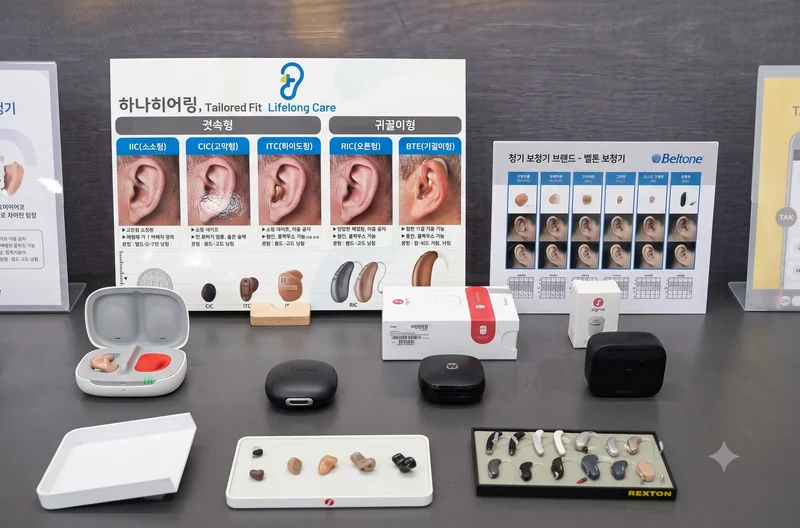
2026.09.03 Cheongnyangni
Average likelihood to recommend
★★★★★
9.77/10
In 2025, 11 directly operated centers, 1,267 valid respondents, 97.9% rating 7 or higher
It's a number we can stand behind, because our fitting is meticulous enough that we'd give it to our own mother without a second thought.
Hearing professionals at Hana Hearing
Hana Hearing center directory

At Hana Hearing centers located across the country, professional
Get started with custom hearing aid service.

Get directions
The hearing aid that's right for me
Find out which brand it is right now.

Guidance to help you choose a hearing aid

From brand comparisons to post-fitting care, you can check everything you're curious about at a glance.

Features and comparison by brandPros and cons of the 6 major brands at a glanceHearing aid types and stylesIn-the-ear / behind-the-ear / open-fitPricing and purchase criteriaInsurance-covered and standard pricing guideHearing aid support guideNational health insurance benefit supportHearing assessment and custom fitting12-step fitting protocolColumns by our audiologistsHearing loss / hearing aid guideCenters by region and bookingOver 40 centers nationwideHearing aid guide by regionHearing aid information for your neighborhoodFrequently asked questionsQuick answers to your questions
Phone inquiry
Talk inquiry KakaoTalk inquiry

Book now